Fire Emergency Evacuation Plan and the Fire Procedure
A fire emergency evacuation plan (FEEP) is a written document which includes the action to be taken by all staff in the event of fire and the arrangements for calling the fire brigade. It can include any relevant information in relation to the FEEP.
General Fire Notice For small premises this could take the form of a simple fire action sign posted in positions where staff and relevant persons can read it and become familiar with its contents.
Staff Fire Notice High fire risks or large premises will need more detailed emergency evacuation plan which takes account of the findings of the fire risk assessment, the staff significantly at risk and their location. In addition, notices giving clear and concise instructions of the routine to be followed in case of fire should be prominently displayed.
In most cases you should nominate persons to implement the fire action plan and give them adequate training in fire fighting and evacuation procedures. The following items should be considered where appropriate:
- Fire evacuation strategy
- Action on discovering a fire
- Action on hearing the fire alarm
- Calling the fire brigade
- Power/process isolation
- Identification of key escape routes
- Fire wardens/marshals
- Places of assembly and roll call
- Fire fighting equipment provided
- Training required
- Personal Emergence Evacuation Plan
- Liaison with emergency services
Fire evacuation strategy
You need to consider how you will arrange the evacuation of the premises in the light of your risk assessment and the other fire precautions you have or intend to put in place.
Simultaneous Evacuation
In most premises, the evacuation in case of fire will simply be by means of everyone reacting to the warning signal given when a fire is discovered, then making their way, by the means of escape, to a place of safety away from the premises. This is known as a simultaneous evacuation and will normally be initiated by the sounding of the general alarm over the fire warning system.
Vertical Phased Evacuation.
In some larger complex premises, the emergency arrangements are designed to allow people who are not at immediate risk from a fire to delay starting their evacuation. It may be appropriate to start the evacuation by initially evacuating only the area closest to the fire and warning other people to stand by. This is normally done by immediately evacuating the floor where the fire is located and the floor above. The other floors are then evacuated one by one to avoid congestion on the escape routes. The rest of the people are then evacuated if it is necessary to do so. The fire warning system should be capable of giving two distinctly different signals (warning and evacuation) or give appropriate voice messages. Horizontal phased evacuation in hospitals and care homes: the floor maybe divided into a number of fire resisting compartments and the occupants are moved from the compartment involved in fire to the adjacent compartment and if necessary moved again. Depending onto the fire situation it may eventually be necessary to consider vertical evacuation. Because of the extra time this type of evacuation takes, other fire precautions maybe be required. These include:
- voice alarm systems
- fire control points
- compartmentation of the premises using fire-resisting construction
- sprinklers in buildings where the top floor is 30 metres or more above ground level
Staff Alarm Evacuation (Silent Alarm)
In some cases it may not be appropriate for a general alarm to start immediate evacuation (Cinemas and Theatres). This could be because of the number of members of the public present and the need for the staff to put pre-arranged plans for the safe evacuation of the premises into action. In such circumstances a staff alarm can be given (by fire records, personal pagers, discreet sounders or a coded phrase on a public address system etc). Following the staff alarm, a more general alarm signal can be given and a simultaneous or phased evacuation started. The general alarm may be activated automatically if manual initiation has not taken place within a pre-determined time.
Defend in Place
This strategy may be considered in blocks of flats were each flat is a minimum 60 minutes fire resisting compartment. It may also be considered in hospitals or nursing homes were patients are connected to life supporting equipment and cannot be moved. The concept allows the occupants to stay put and allow the fire service to extinguish the fire. If the fire spreads and it cannot be controlled then they will initiate a full evacuation. In the case of patients connected to life supporting equipment a decision has to be made which option is the best, stay or move, either way the patient would be at serious risk.
You should only plan to use defend-in-place, phased evacuation schemes or a staff alarm system if you have sought the advice of a competent person and the fire and rescue service.
Action on hearing the fire alarm
On discovering a fire, it is the duty of every person to sound the nearest fire alarm immediately. The plan should include the method of raising the alarm in the case of fire.
The plan should instruct all personnel upon hearing the fire alarm to act in accordance with the agreed FEEP strategy and if a fire warden’s scheme is in force, they, on hearing the alarm, should proceed to pre-determined positions to assist members of the public and staff to leave the building by the nearest safe route.
Lifts and escalators should not be used due to possible electrical failure unless they are part of a Personal Emergency Evacuation Plan.
Personnel should not re-enter the building with the possible exception of the Fire Team.
Calling the fire brigade
The Fire Service should also be informed immediately, either by switchboard operator or person discovering fire, dependant on conditions:
- Work Time – Switchboard operator to be familiar with the emergency evacuation plan, also should ensure necessary extensions switched through when switchboard is unattended.
- Other Times – Remainder of Staff (Cleaners, caretakers etc) also to be familiar with procedure. In any case the most senior official should ensure that Fire Service has been called.
Power/process isolation
Close-Down Procedure – Adopt your own ‘ Close-Down’ procedure as appropriate
Identification of key escape routes
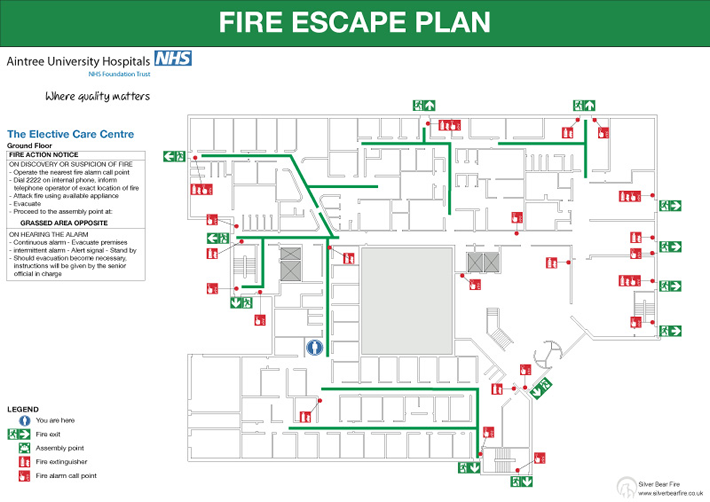
In premises where members of the public or persons unfamiliar with layout of the premises are present there should be means available to identify the key escape routes. They could include schematic drawings and most importantly emergency escape and exit signs.
An Example Fire Escape Plan
Fire Wardens/Marshals
The Responsible Person should nominate employees to implement certain fire safety measures which will include the fire evacuation. The general term used for these people are fire wardens or fire marshals.
The need for fire wardens depends on the size and complexity of the premises. You may require one on each floor or department with a chief fire warden coordinating their actions to make sure all persons are accounted for in the event of a fire. They also require special training above the needs of the normal employee, this training could be in house or by an external fire training organisation. They should be competent in the use of fire extinguishers and be capable of extinguishing small fires. They should have some knowledge of fire prevention and be able to identify possible fire hazards to prevent fire from occurring. Finally they should have an in depth knowledge of the FEEP and their role in implementing it.
The duties and responsibilities of Fire Wardens/Marshals
A senior official in each building [Chief Fire Warden] should be given the responsibility of maintaining a high standard of fire precautions and the overall responsibility for the action in the event of fire. He/she should have a nominated deputy.
Evacuation fire wardens should be appointed for each room/department/floor as applicable and each warden should have a nominated deputy.
Fire Wardens/Marshals should be responsible for
- Fire routine and evacuation drill procedure
- Ensuring personnel know location of fire alarm points
- Ensuring regular use of primary and secondary escape routes
- The close-down procedure
- Procedure for nominated staff to assist employees and members of the public to nearest exits
A senior fire warden/marshall should be made responsible for ensuring that notices are correctly sited, the fire emergency evacuation plan is properly distributed and understood by all.
Assembly points and roll call
Personnel should assemble at a pre-determined assembly point.
- Pre-determined assembly points should be arranged and a roll-call of staff to be taken. The person who is in charge of the assembly point should report to the person who as been nominated the fire service liaison person indicating all persons accounted for or whose missing and where they were last seen.
- Another consideration when selecting the location for an assembly point is to fully understand the fire emergence evacuation plan. Calculate the number of staff that would need to assemble and if it is a multi-occupied building you need to co-operate with the other occupants.
- It is also very important to be familiar with the surrounding topography.
- The assembly point should be far enough away from the building not to put staff in danger of radiated heat and falling debris. Give ample room so you do not interfere with fire fighting operations and do not jeopardise the actions of the fire service.
- Be close enough to ensure that the nominated person who is in charge of the assembly point can communicate with the nominated fire liaison person who should be located near the main entrance. This could be simple talking to him direct or the use of runners or electronic communications (pack sets, mobile phone)
- The area chosen should be larger enough to accommodate all the staff, if this cannot be found you may have to consider additional sites. Open areas are ideal like pedestrian areas, car parks could also be considered but be aware of the dangers.
- The assembly point should not be in an enclosed area and the staff should be able to disperse without the need to pass close to the premises on fire.
- Inclement weather needs to be considered and some form of shelter or other weather protection may be necessary as the staff are most likely to have evacuated without collecting their out-of-doors clothing.
- Use appropriate signs where this is feasible as it leaves no doubts in the minds of staff
Fire fighting equipment provided
A nominated fire team, if available, or any trained competent person should, where possible, attack fire with appropriate equipment, however, fire fighting is always secondary to life safety.
DO NOT PUT ANY PERSONS AT RISK.
Training required
The emergency evacuation plan should be the subject of frequent training so that all employees are familiar with its contents and there should be regular evacuation drills. You are required to carry out this fire training and it is recommended that you keep a record of the results of that training. This will assist you if you are ever required to prove your actions in the future.
Drills should be carried out using varying escape routes assuming the normal evacuation route is not available.
Personal Emergency Evacuation Plan (PEEP)
In order to assist disabled or sensory-impaired people to escape from fire it may be necessary for staff to be trained in the correct procedures to cope with this eventuality. Advice on the specific needs of disabled and sensory-impaired people can be obtained from organisations representing the various groups. The address and telephone number of these organisations can be found in the telephone directory, listed under the appropriate disability. You must take account not only of the people in your premises (employed or otherwise) who may be able to make their own escape, but also those who may need assistance to escape, e.g. by having adequate staffing levels, especially in premises providing treatment or care.
Liaison with emergency services
You should prepare all the necessary contacts with external emergency services and make them familiar with your fire action plan.
As mentioned earlier there should be a senior person nominated to meet the fire and rescue service when they arrived to provide them with any information they require. She/he should have an intimate knowledge of the premises and be in contact with the person conducting the roll call at the assembly point.
Categories:Fire Safety Guides
February 9, 2022[Last updated: February 9, 2022]
Comments are closed here.