Emergency Lighting
Emergency lighting is lighting for an emergency situation when the main power supply is cut and normal electrical illumination fails. The loss of mains electricity could be the result of a fire or a power cut. Without emergency lighting this could lead to sudden darkness and possible danger to occupants, either through physical danger or panic.
Emergency lighting is normally required to operate fully automatically and give illumination of a sufficiently high level to enable all occupants to evacuate the premises safely. Most new buildings have emergency lighting installed during construction; the design and type of equipment being specified by the architect in accordance with current Building Regulations and any local authority requirements.
The British Standard provides the emergency lighting designer with clear guidelines to work to. BS 5266-1 relates not only to hotels, clubs, hospitals, nursing homes, schools and colleges, licensed premises, offices, museums, shops but also multi-storey dwellings. Although the standard recommends the types and backup durations for each category of premises, it should be remembered that standards define a minimum requirement and that a higher specification may be required for a particular application.
What is emergency lighting?
Lighting that automatically comes on when the power supply to the normal lighting provision fails.
Emergency lighting is a general term and is sub-divided into emergency escape lighting and standby lighting.
Emergency escape lighting – that part of an emergency lighting system that provides illumination for the safety of people leaving a location or attempting to terminate a potentially dangerous process beforehand. It is part of the fire safety provision of a building and a requirement of The Regulatory Reform (Fire Safety) Order 2005.
Standby lighting– that part of an emergency lighting system provided to enable normal activities to continue substantially unchanged. This guide does not include standby lighting as it is not a legal requirement and is a facility that may or may not be needed, depending on the use and occupancy of the premises.
Emergency escape lighting is itself sub-divided into escape route lighting, open area lighting and high risk task area lighting.
Escape route lighting – identifies the escape route and keeps it sufficiently lit. This includes illuminated fire exit signs but also emergency lighting such as emergency lighting bulkheads.
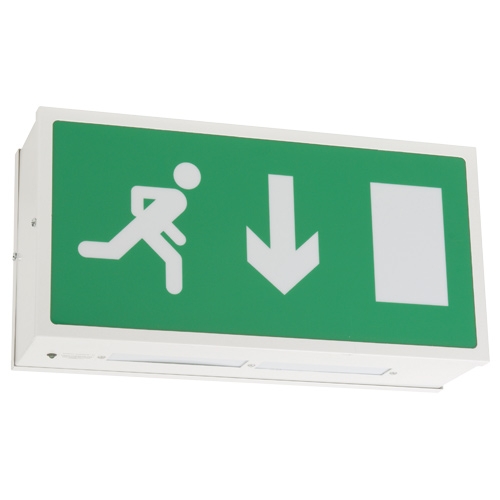
Open area lighting (in some countries known as anti-panic lighting) – ensures that there is sufficient illumination to allow the occupants of a building to reach a place where an escape route can be identified.
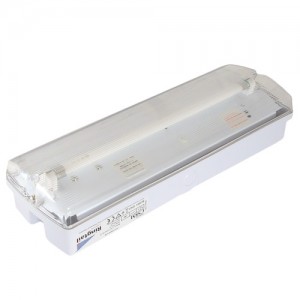
High risk task area lighting – that part of an emergency escape lighting system that provides illumination for the safety of people involved in a potentially dangerous process or situation and to enable proper shut-down procedures for the safety of the operator and other occupants of the premises.
Consultation and design
The first stage of installing emergency escape lighting is consultation and design. The designer, responsible person and fire risk assessor should meet and decide where the escape lighting is required and mark up a plan showing the areas to be covered, the type (power supply), mode of operation, facilities and duration of emergency lighting to be provided in an emergency.
Type (power supply)
Self-Contained – Single Point
Advantages:
- The installation is faster and cheaper
- Standard wiring material may be used
- Failure of mains supply due to cable burn-through will automatically trigger the affected emergency luminaire to come on
- Low maintenance costs – periodic test and general cleaning, only, required
- Low hardware equipment costs – no requirement for extended wiring, special ventilation etc
- The integrity of the system is greater because each luminaire is independent of the others
- System can easily be extended with additional luminaires
- No special sub-circuit monitoring requirements
Disadvantages:
- The environmental conditions will vary throughout the system and batteries may be adversely affected by a relatively high or low ambient temperature
- Battery life is limited to between 2 and 4 years, dependent upon the application
- Testing requires isolation and observation of luminaires on an individual basis
In general, the decision to use either a central battery or a self-contained system is likely to be cost-determined. If an installation has longevity and low maintenance as priorities, then the higher initial cost of a central battery system may be acceptable for a large project. Typically, luminaire and installation costs are a major consideration, particularly on smaller jobs, and it is this criterion which makes the self-contained luminaire the most popular choice.
Central Battery Source
Advantages:
- Maintenance and routine testing is easier, with only one location to consider
- The life of a battery is between 5 and 25 years, dependent upon type
- Environmentally stable in a protected environment; the slave luminaire can operate at relatively high or low ambient temperatures
- Large batteries are cheaper per unit of power and luminaires are usually less expensive
Disadvantages:
- High capital equipment costs
- The cost of the installation and system wiring is high because fire resisting cable is required to each slave luminaire
- Poor system integrity – failure of battery or wiring circuit can disable a large part of the system
- A requirement for ‘battery room’ to house cells and charger circuits, etc; ventilation of acid gases may also be needed
- Localised mains failure may not trigger operation of emergency lighting in that area
- Voltage drop on the luminaire wired furthest from the central battery could become a problem
Mode of operation
Maintained or non-maintained is the principal consideration, which is decided by the use of the premises.
Maintained emergency luminaire: a luminaire in which the emergency lighting lamps are on at all times.
Maintained mode is generally used in places of assembly such as theatres, cinemas, clubs and halls; the full list is contained in BS 5266. The lights are typically dimmed when these premises are occupied and the emergency escape lighting prevents total darkness.
Maintained fire exit signs are also used in public spaces even where these are well lit to offer clear escape route guidance in evacuation situations where the power does not fail.
Non-maintained emergency luminaire: a luminaire whose emergency lamps only come on when the power supply to the normal lighting fails. Non-maintained is the typical mode in a workplace or similar environment in which artificial lighting is normally deployed while the premises are occupied.
Combined emergency luminaire: a luminaire containing two or more lamps, at least one of which is energized from the emergency lighting supply and the other(s) from the normal lighting supply. A combined emergency luminaire can be either maintained or non-maintained. These are also called switchable emergency lights.
Facilities
A) Luminaire including test device: the luminaire contains a self-test module for testing purposes.
B) Luminaire including remote test device: the system is tested remotely by a centralised panel.
C) Luminaire with inhibiting mode: a control mode used to inhibit the emergency lighting luminaire from operating, thus preventing the discharge of the emergency lighting batteries at times when the building is unoccupied. If a mains failure occurs at such a time, the batteries will remain fully charged so that the building can be occupied when required. It is performed by an inhibitor switch that must be interfaced with other building services so that the premises cannot be inadvertently occupied without the emergency lighting being recommissioned.
D) High risk task luminaire: for risk task area lighting in areas of high risk, the maintained luminance shall not be less than 10% of the required maintained luminance for the task under normal lighting conditions. This will be subject to a minimum luminance of 15 lux. The uniformity ratio for task area lighting should be a minimum of 10:1 (0.1). The minimum duration shall be the period for which the risk presents to occupants.
Duration
The time required to evacuate the premises depends on their size and complexity. The duration itself is dependent not only on evacuation time but also on whether the premises are evacuated immediately the power and normal lighting fails and are re-occupied immediately the supply is restored. The minimum duration of an emergency escape lighting system is 1 hour. That means that once the power supply fails, the luminaires must remain on for at least one hour.
A minimum duration of 3 hours should be used for emergency escape lighting if the premises are not evacuated immediately, as in the case of sleeping accommodation, for example, or if the premises will be reoccupied immediately the supply is restored without waiting for the batteries to be recharged.
One hour’s duration should only be used if the premises are evacuated immediately on supply failure and not reoccupied until full capacity has been restored to the batteries.
BS 5266 contains detailed information on the recommended duration of systems in various premises.
Emergency lighting classifications
The old NM or M classification with duration in hours has been replaced with a code consisting of letter/number/letter/number, as follows:
1) Type
X – self-contained
Y – central battery
2) Mode of operation
0 non-maintained
1 maintained
2 combined non-maintained
3 combined maintained
further modes are also described
3) Facilities
A including test device
B including remote test device
C including inhibiting mode
D high risk task luminaire
4) Duration in minutes.
10, 60,120 or 180
The classification is expressed as per the following example:
[x][0][***][180] – Self-contained, Non-maintained, ***, 3 hours duration.
*** This is added as applicable at the time of installation.
Siting of luminaires and emergency signs
Having decided on your basic system, consideration should now be given to the siting of the emergency lighting units and signs within the particular premises involved. This will then form the basis on which your selection of equipment can be made. Safelincs provides a graphical guide for the location of emergency lights.
Lighting units and signs should be sited so as to clearly show the exit routes leading to the final exits from the premises. Where the exit route or final exit is not readily identifiable, a sign should be utilised rather than a lighting unit. Particular attention should be paid to individual stairways, changes in floor level, corridor intersections, changes in direction, the outside of each final exit, control / plant rooms, lifts, toilet areas over 8m2 (although there is an argument for providing all toilets with public access, and especially those for the disabled, with emergency lighting). Access to fire alarm call points and fire fighting equipment should be clearly illuminated.
It is not necessary to provide individual lights (luminaires) for each item above, but there should be a sufficient overall level of light to allow them to be visible and usable.
N.B: detailed computer point calculations or luminaire manufacturers’ spacing tables should be used. The above is a brief summary and we recommend that the appropriate standard is studied to gain a full understanding of what is involved.
How much light?
BS 5266 recommends the provision of horizontal illumination at floor level along the centre line of a defined escape route (permanently unobstructed) not less than 1 lux, and 0.5 lux for anti-panic areas, to exclude a 0.5m border around the route. In addition, for escape routes of up to 2m wide, 50% of the route width should be lit to a minimum of 1 lux. Wider escape routes can be treated as a number of 2m wide bands. The actual degree of illumination should be closely related to the nature of both the premises and its occupants, with special consideration being given to care homes for the elderly, hospitals, crowded venues such as pubs, nightclubs and supermarkets, and to whether or not the premises have overnight accommodation, e.g. hotels.
The level of illumination in certain rooms and areas within a building will vary depending on their use; all this information is contained in the appendices to BS 5266-1.
N.B: The above is a brief summary and we recommend that the appropriate standard is studied to gain a full understanding of what is involved.
Commissioning Certificate and Logbook
BS 5266 requires written declarations of compliance to be available on site for inspection. These should detail the quality of the installation and its conformance to IEE regulations, including the main circuit of the normal lighting system feeding non-maintained fittings.
Photometric performance is required and evidence of compliance with light levels has to be supplied by the system designer.
On completion of the installation of the emergency lighting system, or part thereof, a completion certificate should be supplied by the installer to the occupier / owner of the premises.
A declaration of satisfactory test of operation is necessary and a log of all system tests and results must be maintained. System logbooks, with commissioning forms, testing forms and instructions, should be provided by the installer.
A free fire safety logbook with sections for emergency lighting tests can be downloaded for free from Safelincs.
Maintenance
Finally, to ensure that the system remains fully operational, essential servicing should be specified. This would usually be performed as part of the testing routine, but in the case of consumable items such as replacement lamps, spares should be provided for immediate use.
Servicing and testing
To test an emergency lighting system, a mains power failure on the normal lighting circuit / circuits or individual luminaries must be simulated. This will force the emergency lighting system to operate via the battery supply. This test can be carried out manually or automatically.
Manual testing
A simulated mains failure can be achieved by providing a switch to isolate all lighting circuits / individual circuits / individual luminaires. If manual testing is utilised, the following points should be considered:
In a system with a single switch for the whole building or a large circuit, after simulating the mains failure it is necessary for the tester to walk the whole building or circuit, to check all emergency luminaire are operating correctly. After restoring the mains supply, the whole building or circuit must be walked again, to check that the emergency lights are recharging.
If the emergency luminaires are individually switched, only a single walk around the building will be needed. However, the test switches could spoil the decor of the building and they must be of a type that is tamper proof. After the tests, it is recommended that the performance of the system is logged in the fire safety logbook.
Automatic testing
If the costs of an engineer’s time and the disruption caused by manual testing are excessive, self-testing emergency lighting should be considered. Different formats are available to match particular site requirements. However, the results of the monthly and annual tests must still be recorded.
General information about emergency lighting testing
BS EN 50172 / BS 5266-8 (Emergency escape lighting systems) specify the minimum provision and testing of emergency lighting for different premises. Additional information on servicing can be found in BS 5266-1: (Code of practice for the emergency lighting of premises).
Discharge tests need to be undertaken outside normal working hours. In buildings that are permanently occupied, the test should be phased so only alternate luminaires are tested.
Regular servicing is essential. The occupier / owner of the premises shall appoint a competent person to supervise servicing of the system. This person shall be given sufficient authority to ensure the carrying out of any work necessary to maintain the system in correct operational mode.
Because of the possibility of a failure of the normal lighting supply occurring shortly after a period of testing of the emergency lighting system or during the subsequent recharge period, all full duration tests shall, wherever possible, be undertaken just before a time of low risk to allow for battery recharge. Alternatively, suitable temporary arrangements shall be made until the batteries have been recharged.
The following minimum inspections and tests shall be carried out at the intervals recommended below. The regulating authority may require specific tests.
Daily emergency lighting inspection (only for central back-up systems)
This check only applies to emergency lighting systems with a central back-up battery system. In this case, there is a daily visual inspection of indicators on the central power supply to identify that the system is operational. No test of operation is required. This test does not apply to emergency lighting with self-contained back-up batteries in each unit (standard emergency lighting).
Monthly emergency lighting tests
All emergency lighting systems must be tested monthly. The test is a short functional test in accordance with BS EN 50172 / BS 5266-8.
The period of simulated failure should be sufficient for the purpose of this test while minimising damage to the system components, e.g. lamps. During this period, all luminaires and signs shall be checked to ensure that they are present, clean and functioning correctly.
Annual emergency lighting tests
A test for the full rated duration of the emergency lights (e.g. 3 hours) must be carried out. The emergency lights must still be working at the end of this test.
The result of the monthly and annual tests must be recorded and, if failures are detected, these must be remedied as soon as possible.
It is common for fire alarm servicing companies to carry out the annual emergency light ‘drain’ test at the same time as they carry out fire alarm system maintenance, as this fills the waiting time of the ‘drain’ test with useful activity.
British and European Standards – Emergency Lighting
Emergency lighting is now covered by a series of interdependent standards that can be seen as forming a hierarchy as shown below.
Base guidance document
BS 5266-1 Code of practice for emergency lighting of premises. Gives general rules and guidance on the provision and operation of emergency lighting in most premises other than dwelling houses.
System standards
BS EN 1838 Lighting applications – emergency lighting. Specifies the illumination to be provided by emergency lighting (including luminance, duration and colour).
BS EN 50172 / BS 5266-8 Emergency escape lighting systems. Specifies the minimum provision and testing of emergency lighting for different premises.
Product standards
BS EN 60598-1 Luminaires. General requirements and tests. See the 60598 series for particular requirements.
BS EN 62034 Automatic test systems for battery powered emergency escape lighting. Specifies a test system for battery powered emergency lighting
BS EN 50171 Central power supply systems. Specifies central power supply systems for emergency lighting luminaries.
The Regulatory Reform (Fire Safety) Order 2005
The HM Government entry level guides to the RRFSO for different types of non-domestic premises and the communal areas in HMOs each have a section entitled “Further guidance on emergency escape lighting”, which provide additional relevant information. The guides can be accessed via this link: Regulatory Reform (Fire Safety) Order guides.
Categories:Fire Safety Equipment
March 15, 2011[Last updated: November 11, 2019]
Comments are closed here.