Merseyside Fire Liaison Panel Logo


Note for Guidance

The Fire Safety Advice Centre

Safelincs - Your Safety Provider

The Furniture and Furnishings (Fire) (Safety) Regulations


Introduction

The Furniture and Furnishings (Fire Safety) Regulations 1988 (as amended in 1989 and 1993) set levels of fire resistance for domestic upholstered furniture, furnishings and other products containing upholstery. This guide is intended to give an overview of the responsibilities of companies involved in the supply of upholstered furniture and is intended to help suppliers of these products understand how the new Regulations affect them. It is not an authoritative interpretation of the Regulations, which is a matter for the courts. The guide explains the requirements in general terms, but it does not cover all the details. You should refer to the BERR Guide to the Regulations for more detailed information and (Statutory Instrument No. 1324) and (Statutory Instrument 1989 No. 2358) themselves for a full statement of the requirements.

The Furniture and Furnishings (Fire) (Safety) Regulations are enforced by the Local Trading Standards Department. Manufactures, those providing materials and retailers of upholstered furniture or those letting out properties or who are renting themselves should contact their Local Trading Standards Department via their local Council if they require advice, clarification or wish to take enforcement action.

Product ranges covered

It includes any upholstered furniture which is intended for private use in a dwelling, including children's furniture. It also includes,

  • beds, head-boards of beds, mattresses (of any size)
  • sofa-beds, futons and other convertibles
  • nursery furniture
  • garden furniture which is suitable for use in a dwelling
  • furniture in new caravans
  • scatter cushions and seat pads
  • pillows
  • loose and stretch covers for furniture

The Regulations do not apply to:

  • sleeping bags
  • bed-clothes (including duvets)
  • loose covers for mattresses
  • pillowcases
  • curtains
  • carpets

Persons subject to the Regulations

The Regulations apply to persons who supply materials, manufacturers, retailers of upholstered furniture and those that provide re-upholstery services and include,

Group 1 - Suppliers

  • Persons who supply filling material and fabrics to the furniture industry or direct to consumers.

Group 2 -Manufacturers

  • Persons who manufacturers domestic upholstered furniture and furnishings.
  • Re-upholsterers

Group 3 - Providers

  • Importers
  • Wholesalers
  • Retailers (including mail order traders)
  • Persons who hire out furniture
  • Persons who supply second-hand furniture in the course of business or trade. This includes auctioneers and some charities (Note 1)
  • Persons who rent furnished accommodation in the course of a business, including estate agents and letting agents. (Note 2)

Note 1 The simple distribution of second-hand furniture by a charity in pursuance of its charitable objectives to needy persons, either free of charge or at a nominal amount only, would be unlikely to constitute a supply in the course of business. On the other hand, shops selling furniture to raise funds for charitable purposes would constitute a business activity and the Regulations will apply to the furniture sold in this case. Individual charities should take legal advice on the circumstances surrounding all their particular operations.

Note 2 The Regulations apply to furniture and furnishings included in holiday homes and residential furnished accommodation (such as houses, flats and bed-sits) which is let in the course of business. They therefore affect persons (including estate agents and letting agents) who let such accommodation as a business activity. You will need to take further advice as this area is quite complicated.

All furniture made before 1950, and re-upholstery of furniture made before that date also the exports of furniture are exempt.

What suppliers need to do?

Any filling material supplied direct to consumers (whether foam or non-foam) and filling material supplied to business users for use in furniture or re-upholstery must pass the appropriate tests. Non-foam fillings which are supplied to furniture manufacturers and re-upholsters need not pass any fire resistance test consequently furniture manufacturers and re-upholsterers will be responsible for ensuring that any non-foam filling material used in furniture provides the required level of fire resistance. In other words, if the filling material is to form part of a composite filling, the manufacture must ensure that the final composite passes the appropriate tests. If, on the other hand, the filling materials are to be used as a single filling in the finished article, the furniture manufacturer should specify his requirement for a filling material which passes the single filling test.


Suppliers of filling material, whether they supply direct to consumers or to business users, are strongly advised to ask the purpose for which the filling material is sought and give advice to the user about its suitability for use in furniture etc.

Any fabric supplied to provide or replace the permanent cover on furniture, except mattresses, bed-bases, pillows, cushions and baby nests, must pass the appropriate match test, which depend on whether the fabric is to be used to provide a visible or non-visible part of the cover. If it is one of the fabrics listed below, it can be offered in non-match-resistant form, provided that the furniture has or will contain a fire-resistant interliner which itself passes the specified test. These are fabrics made from material containing at least 75 per cent by weight of cotton, flax, viscose, modal, silk, wool. Whether used separately or together and are not coated with polyurethane or a polyurethane preparation.

This requirement applies to any person who supplies fabric to the trade or direct to the consumer where he knows or has reasonable cause to believe that it will be used for covering furniture, except mattresses, bed-bases, pillows, cushions and baby nests. Therefore, suppliers need to ask the purpose for which the fabric is sought and give advice about its suitability for use on furniture, and the conditions under which it can so be used. Fabric suppliers should be aware that furniture manufacturers will need to know whether the fabric which they are ordering will enable the complete furniture to pass the appropriate cigarette test, again depending on whether the fabric is to be used to provide a visible or non-visible part of the upholstery. However, these tests can only be carried out on the final upholstery composite which will not always be known to the fabric supplier. We suggest therefore that the supplier arranges to have the cover fabric tested for cigarette resistance using standard polyurethane foam. This will enable him to give the furniture manufacturer a good indication of its likelihood to pass the appropriate cigarette test for the finished article.

What manufacturers need to do?

Manufacturers of domestic upholstered furniture which includes all upholstered seating furniture, including children's furniture, as well as upholstered articles such as music stools, foot stools and pouffes, bean bags and floor cushions, which are intended for private use in a dwelling. It also applies if it is supplied in kit form for self-assembly and whether complete or ordered with the customers' own choice of cover fabric. The products must pass the appropriate cigarette test, contain only filling material which passes the appropriate test and the cover fabric must also pass the appropriate match test or if it is one of the fabrics listed below, it can be in non-match-resistant form, provided that the furniture has or will contain a fire-resistant interliner which itself passes the specified test. These are fabrics made from material containing at least 75 per cent by weight of cotton, flax, viscose, modal, silk, wool. Whether used separately or together and are not coated with polyurethane or a polyurethane preparation. Also carry the appropriate display and permanent labels.

The responsibility of the manufacturer is to ensure the cover materials meet the cigarette test and the filling materials meet the relevant tests. Also a permanent label is fixed to the product, when required, and display labels are attached to the product. The match test is the responsibility of the supplier.

What providers need to do?

When providers obtain domestic upholstered furniture from a manufacturer or other source for their commercial undertaking they are subject to the regulations and need to ascertain if the products meet the requirements of the regulations and all the necessary labels are attached to the product.

Trading Standards Officers have powers to inspect products and related documents. From 1 November 1988 any person who supplies new furniture, or loose covers or stretch covers, which carries the shorter permanent label must make available to an enforcement agency, on request, certain information about the furniture, or loose or stretch covers. This information, which should be readily available for inspection and contain the following details:
  1. The name and the postal code of the address of the first supplier, manufacturer or importer.
  2. The date on which the article was manufactured or imported.
  3. The description of all the filling materials included in the article.
  4. The description of all the covering materials included in the article.

Certain articles do not require all of the above information to be provided.

Article
Relevant items for full label
Loose covers and Stretch covers for furniture
1 and 4
Pillows,scatter cushions and seat pads
1 and 3
Cots carry-cots, playpen, push chairs and other similar articles designed to contain a baby or small child
1, 3 and 4

A list of articles together with the information must be provided and therefore retailers need to ensure that the manufacturer or importer, or any intermediary supplier, provides the above details for supplies of furniture which carry the shorter label. This information could be included, for example, on the supplier's invoice to the retailer. Retailers must retain this information

The labels

Display labels

All new furniture except:

  • mattresses and bed-bases
  • pillows, scatter cushions and seat pads
  • loose cover and stretch covers for furniture

They must carry a display label at the point of sale. It is the retailer's responsibility to ensure that furniture on display carries the correct label.
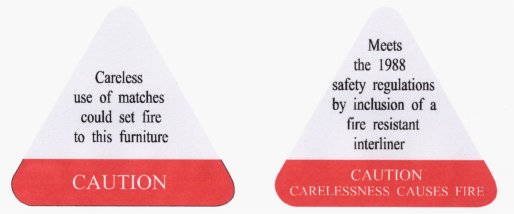
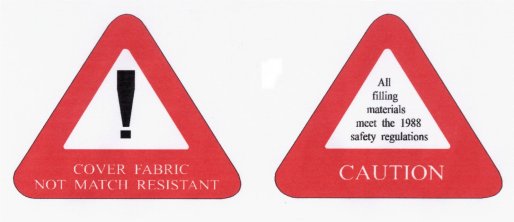
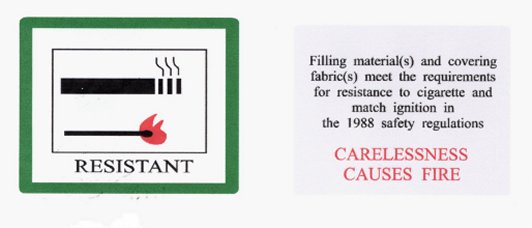
The Regulations contain full-size illustrations of display labels in colour. Reduced illustrations are shown below to explain the meaning of the labels.
Furniture sold as a collection of items, such as three-piece suites, must carry the appropriate display label on each individual item.
In all cases the display label must be attached to the furniture in a prominent position so that the label will be clearly visible to a potential purchaser of the furniture and the wording on both sides can be read with reasonable ease.

The Regulations do not require the following items to carry a display label:

  • mattresses and bed-bases
  • pillows, scatter cushions and seat pads
  • loose covers and stretch covers for furniture

Appropriate to new furniture which meets the filling requirements and is cigarette resistant. This applies to the likes of baby nests and the word "product" may be substituted for the word "furniture" on the second side of this label.


Appropriate to new furniture with a limited range of cover fabrics. The cover fabric is not match resistant, but the furniture has an interliner which passes the specified test. The furniture meets the filling requirements and is cigarette resistant.
Appropriate to new furniture which meets the filling requirements and is both cigarette and match resistant.

Permanent labels

All new furniture and loose and stretch covers for furniture must carry a permanent label,except mattresses and bed-bases. It is primarily the responsibility of the first supplier i.e. the manufacturer or the importer to ensure that the label gives the necessary information, but retailers are also under a duty to ensure that the permanent label is on the goods when they supply them to the consumers.

Choice of permanent label

The manufacturers or the importer can choose between two versions of the permanent label either a label giving full information about the furniture or a shorter label giving only the minimum information about the furniture.

Where the first supplier decides to use the shorter label, any person who supplies that furniture must make available to the enforcement agency, on request, certain information about the furniture.

A full description of what must be included in these labels is given in Parts II and III, respectively, of Schedule 7 to the Regulations. Completed examples of the labels are shown below. (These are illustrations only.)

Size of letters

All words and numbers on the permanent label must be in medium letters of at least 10 point (approx 2.5 millimetres high) in upper or lower case. The letters must be legible, in durable print, and appear on a label of sufficient colour contrast to enable them to be seen clearly.

Position of the label

The label must be securely attached to the furniture (i.e. cannot be removed without causing damage to the label or the product). It may appear on any external surface of the article. In the case of seating furniture the platform underneath any removable seating cushions may be regarded as an external surface for this purpose. Furniture sold as a collection of items, such as three-piece suites, must carry a label on each individual item. In the case of loose or stretch covers for furniture the label may appear on the underside of the fabric.

The following are examples of the permanent label for an item of domestic upholstered furniture.

Information on a label giving full information

Information
Example
a
Caution
Carelessness causes Fire
b
Name abd address of the first supplier in the UK
A.N.Other Ltd AB1 2XY
c
Batch Number or Identification number
AB 1234
d
Date Manufactured or Imported
1 March 1990
e
Description of Filling material
This article contains CM foam which passes the specified test. All upholstery is cigarette resistant
f
Description of Covering material
All cover fabric is cotton and match resistant
g
Whether or not the article includes a fire resistant interliner
This article does not include a Scedule 3 interliner

Example of shorter label:

Information
Example
a
Caution
Carelessness causes Fire
b
Batch Number or Identification number
Batch/ID DF 1234
c
Whether or not the article includes a fire resistant interliner
This article does not include a Scedule 3 interliner
d
Summary for the measures taken to ensure compliance with regulations
All foams, fillings and composites have been tested to ensure compliance with the relevant ignitability test. All covers and fillings have been tested to ensure they are cigarette resistant. All covers have been tested to ensure that they are match resistant.
 
Further Details are available from your retailer.

Reduced information for some articles

Certain articles do not require all the above information to be given. The following is a list of these articles, together with the information which needs to be given on the full and shorter variants of the label.

Article
Relevant items for full label
Relevant items for shorter label
Loose covers and Stretch covers for furniture
a, b amd f

a, and d

Pillows,scatter cushions and seat pads
a, b and e
a and d
Cots carry-cots, playpen, push chairs and other similar articles designed to contain a baby or small child
a, b, e, and f
a and d

BS 7177: 1989 contains specifications for labeling mattresses and bed-bases.

Test Requirements of different kinds of Furniture and Furnishings

ITEM
 
TEST DESCRIPTION
 
TEST REQUIREMENT
         
1) Upholstered furniture        

Including sofa-beds, other convertibles, nursery furniture, garden furniture and caravan furniture.

  Cigarette resistance of visible parts of upholstery   The cigarette test of BS 5852: Part
1 as modified by Schedule 4, Part I of the Regulations. The test is applied to the actual composite used.
    Cigarette resistance of non-visible parts of upholstery   The cigarette test of BS 5852: Part
1 as modified by Schedule 4, Part II of the Regulations. The test is applied to the actual composite used.
    Foam fillings    
    Polyurethane foam in slab or
cushion form
  Ignition Source 5 of BS 5852: Part
2 using cover specified in Schedule
1, Part I of the Regulations.
    Polyurethane foam in crumb form   Must be derived from above and
meet Ignition Source 2 of BS 5852:
Part 2 using cover specified in
Schedule 1, Part I of the Regulations
    Latex rubber foam   Ignition Source 2 of BS 5852: Part
2 using cover specified in Schedule 1, Part I of the Regulations.
    Non-foam fillings   Single fillings Ignition Source 2 of BS 5852: Part 2 using cover specified in Schedule 1, Part I of the Regulations.
    Composite fillings   Ignition Source 2 of BS 5852: Part
2 using cover specified in Schedule
1, Part I of the Regulations.
    Match resistance test    
    For all visible covers except stretch covers, scatter cushion covers and specified cover fabrics when used over specified interliner   The match test of BS 5852: Part 1
over foam specified in Schedule 5,
Part I of the Regulations.
    For no visible covers   The match test of BS 5852: Part 1
over foam specified in Schedule 5,
Part III of the Regulations.
         
2) Baby nests   Cigarette resistance test    
    Cigarette resistance of visible parts of upholstery   The cigarette test of BS 5852: Part
1 as modified by Schedule 4, Part I of the Regulations. The test is applied to the actual composite used.
    Cigarette resistance of non-visible parts of upholstery   The cigarette test of BS 5852: Part
1 as modified by Schedule 4, Part II of the Regulations. The test is applied to the actual composite used.
    Foam fillings    
    Polyurethane foam in slab or
cushion form
  Ignition Scour 5 of BS 5852: Part 2 using cover specified in Schedule 1, Part I of the Regulations.
    Polyurethane foam in crumb form   Must be derived from above and
meet Ignition Source 2 of BS 5852:
Part 2 using cover specified in
Schedule 1, Part I of the Regulations.
   
Latex rubber foam
  Ignition Source 2 of BS 5852: Part
2 using cover specified in Schedule
1, Part I of the Regulations.
    Non-foam fillings    
    Single fillings   Ignition Source 2 of BS 5852: Part
2 using cover specified in Schedule
1, Part I of the Regulations.
    Composite fillings   Ignition Source 2 of BS 5852: Part
2 using cover specified in Schedule
1, Part I of the Regulations.
         
3) Head-boards for beds   Cigarette resistance test    
    Cigarette resistance of visible parts of upholstery   The cigarette test of BS 5852: Part
1 is modified by Schedule 4, Part I of the Regulations. The test is applied to the actual composite used.
    Foam fillings    
    Polyurethane foam in slab or
cushion foam
  Ignition Source 5 of BS 5852: Part
2 using cover specified in Schedule
1, Part I of the Regulations.
    Polyurethane foam in crumb form   Must be derived from above and
meet Ignition Source 2 of BS 5852:
Part 2 using cover specified in
Schedule 1, Part I of the Regulations.
    Latex rubber foam   Ignition Source 2 of BS 5852: Part
2 using cover specified in Schedule
1, Part I of the Regulations.
    Non-foam fillings    
    Single fillings   Ignition Source 2 of BS 5852: Part
2 using cover specified in Schedule
1, Part I of the Regulations.
    Composite fillings   Ignition Source 2 of BS 5852: Part
2 using cover specified in Schedule
1, Part I of the Regulations.
    Match resistance test for all visible covers except stretch covers, scatter cushion covers and limited range of cover fabrics when used over specified interliner.   The match test of BS 5852: Part 1, over foam specified in Schedule 5, Part I of the Regulations.
         
4) Interliner  

Test for interliner used with a
limited range of fabrics


Ignition Source 5 of BS 5852: Part 2 using cover fabric and foam filling specified in Schedule 3 of the Regulations.

         
5) Loose covers   Match test for loose covers   The match test of BS 5852: Part 1
over foam specified in Schedule 5,
Part I of the Regulations
         
6) Stretch covers   Match test for stretch covers   The match test of BS 5852: Part 1
over foam specified in Schedule 5,
Part II of the Regulations.
        No requirement for any cigarette
test for loose or stretch covers.
         
7) Mattresses and bed-bases   Foam fillings   As for Item 1 above.
    Non-foam fillings    
    Single fillings   As for Item 1 above
    Composite fillings   Ignition Source 2 (of BS 5852: Part
2) using BS 6807 as method of test
         
8) Pillows Fillings   Foam fillings   As for Item 1 above.
    Non-foam fillings    
    Single fillings   As for Item 1 above
   

or

   
    Fillings tested with the primary
cover as a composite
  Ignition Source 2 of BS 5852: Part
2.
        No requirement for any cigarette or
match test.
         
9) Scatter cushions and seat pads   Foam fillings   As for Item 1 above.
    Non-foam fillings    
    Single fillings   As for Item 1 above
    or    
    Fillings tested with the primary
cover as a composite
  Ignition source 2 of BS 5852: Part
2 using the cover specified in
Schedule 1, Part I of the Regulations.
        No requirement for any cigarette or
match test.

Further Information

I understand some small manufacturer have had problems sourcing these labels and cannot find a printer who can supply them. I found a company Nelsons Labels (Manchester) Ltd. that stocked the appropriate labels also CPS (Wales) Ltd, although I am sure there must others in the UK.

I would suggest you first download Guide to the Regulations and fully understand the type of labels required for your products. Then contact Nelsons or CPS and if you wish to see a selection of the labels available, you can download from Nelson Fire Labels.

The British Furniture Confederation has a forum were you will be able to ask your questions to like minded people and hopefully get informed answers.

The Furniture Industry Research Association has a wealth of information regarding Furniture.


This handout provides a general overview and basic information on this topic. It may not apply to everyone, consequently to find out if this guide applies to you and to get more information on this subject, study all the relevant legislation, guides and British/European Standards. Also you should seek advice from an expert on the subject or your local Fire Safety Officer or Fire Safety Professional.

I would be much obliged if you would sign the guestbook and make your comments about the web site. Also include your constructive criticism on the site and inform me if any information which is out of date so I can research it to bring it up todate. This will enable me to improve the site and make it more relevant to its users.

Merseyside Fire Liaison Panel Logo
Merseyside Fire Liaison Panel. Permission is granted to print and photocopy this material for nonprofit educational uses.

[Index]

This page was last checked and modified on Tuesday, 21 April, 2009 9:37


    mersey world icon