History of Fire Extinguishers
In about 200 BC, Ctesibius of Alexandria invented a hand pump able to deliver water to a fire and it is known that the Romans used bucket chains – buckets passed hand-to-hand to deliver water to the fire. Then, in the Middle Ages, ‘squirts’ began to be used to apply jets of water to fires. The squirt worked rather like a bicycle pump. The nozzle was dipped into water and about one litre was sucked up by pulling out the plunger. The charged squirt was then directed at the fire and the plunger pushed home to eject the water. Squirts were used on the 1666 Great Fire of London. The first version of the modern portable fire extinguisher was invented by Captain George William Manby in 1819, consisting of a copper vessel of 3 gallons (13.6 litres) of pearl ash (potassium carbonate) solution under compressed air pressure.
Around 1912 Pyrene pioneered the carbon tetrachloride or CTC extinguisher, where the liquid was expelled from a brass or chrome container by hand pump, onto a fire. The sizes were usually of 1 imperial quart (1.1 L) or 1 imperial pint (0.6 L) capacity but also made in up to 2 imperial gallon (9 L) sizes. The CTC vapourised and extinguished the flames by interfering with the chemical reaction. This extinguisher was suitable for liquid and electrical fires and was popular in motor vehicles for the next 60 years. The vapour and combustion by-products were highly toxic and deaths did occur from using these extinguishers in confined spaces.
The late 19th century saw the invention of the soda-acid extinguisher, where a cylinder contained 1 or 2 gallons of water that had sodium bicarbonate mixed in it. Suspended in the cylinder was a vial containing concentrated sulphuric acid. The vial of acid was broken by one of two means depending on the type of extinguisher. One involved the use of a plunger that broke the acid vial, while the second involved the release of a lead bung that held the vial closed. Once the acid was mixed with the bicarbonate solution, carbon dioxide gas would be expelled and this would in turn pressurise the water. The pressurised water was forced from the canister through a short length of hose and a nozzle. The acid was neutralised by the sodium bicarbonate.
Foam extinguishers consisted of the main body of the extinguisher filled with foam-producing chemical and a second container filled with another chemical which reacts when it came into contact with the solution in the main cylinder. To operate you would turn the extinguisher upside down and allow the two solutions to mix, then hold your finger over the discharge nozzle and shake the extinguisher to ensure the solution was properly mixed, then direct it at the fire.
In the middle of the twentieth century the modern type of extinguisher appeared using different extinguishing agents. Manufacturers of extinguishers generally use some type of pressurised vessel to store and discharge the extinguishing agent.
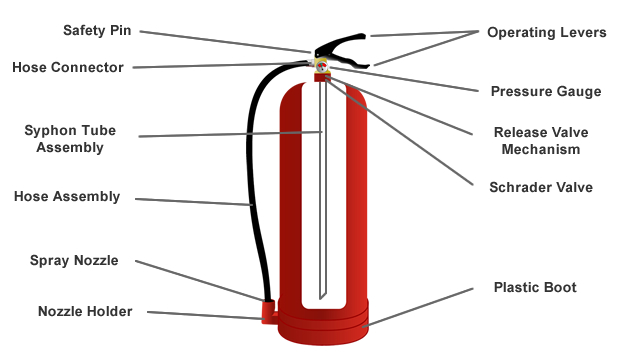
The first type of fire extinguishers (Fig. 1) are pressurised with air to approximately 10 bar, five times a car tyre pressure, from a compressor. A squeeze-grip handle operates a spring-loaded valve threaded into the pressure cylinder. Inside, a pipe or dip tube extends to the bottom of the extinguisher so that in the upright position, the opening of the tube is submerged. The extinguishing agent is released as a steady stream through a hose and nozzle, pushed out by the stored pressure above it.
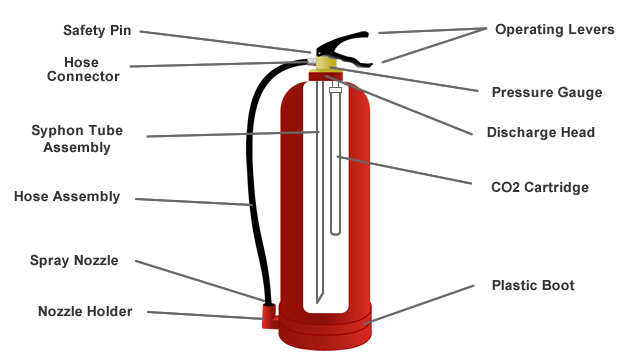
The second type of fire extinguishers (Fig. 2) are the “gas cartridge” type. These are operated in the same manner, but the pressure source is a small cartridge of carbon dioxide gas (CO2) at 130 bars, rather than air. A squeeze-grip handle operates a spring-loaded device causing a pointed spike to pierce the disc that held back the pressure, releasing the gas into the pressure vessel. The released CO2 expands several hundred times its original volume, filling the gas space above the extinguishing agent. This pressurises the cylinder and forces the extinguishing agent up through a dip-pipe, out through a hose and nozzle to be directed upon the fire. This design proved to be less prone to leak down, a loss of pressure over time, than simply pressurising the entire cylinder.
For water, foam, dry powder and wet chemical extinguishers, the extinguishing agents can either be put under stored pressure, or a gas cartridge expeller can be used, however the stored-pressure type is more widely used. Gas cartridge extinguishers are now mainly used on ships and refineries. Dry powder extinguishers generally use the CO2 cartridge method to prevent the powder being affected by moist air used for the stored pressure method. In carbon dioxide extinguishers, the CO2 is retained in liquid form under 50 to 60 bar and is self-expelling, meaning that no other element is needed to force the CO2 out of the extinguisher. In halon units, the chemical is also retained in liquid form under pressure, but a gas booster, usually nitrogen, is generally added to the vessel. The nozzles are the main difference; water has a circular nozzle which forms a solid jet which can penetrate to the heart of the fire. Foam has a miniature foam nozzle that aerates the foam solution and forms a floppy stream of foam that can be gently applied to the surface of the liquid. Dry Powder has an elliptical nozzle which spreads the powder and prevents air being entrained. Wet Chemical has a nozzle that creates a fine spray which allows you to apply the extinguishing agent gently. Carbon dioxide has a discharge horn which slows down the jet of gas and prevents air being entrained. It is important to choose CO2 extinguishers with frost-free horns to avoid getting frost-burn.
In 2011 Britannia introduced the first self-maintenance extinguishers, which for the first time in extinguisher history do not require service engineers to visit sites and maintain them. These P50 Fireworld branded units overcame the problem of corrosion, lining damage and pressure loss by being designed of composite plastics, Aramid and brass. They withstand higher pressures than ordinary steel extinguishers, cannot corrode and do not require any attention other than ensuring that the units are not missing, damaged or discharged. They do not require refills after 5 year, either. They are kitemarked and MED approved.
Extinguishing Agents
Water Extinguishers
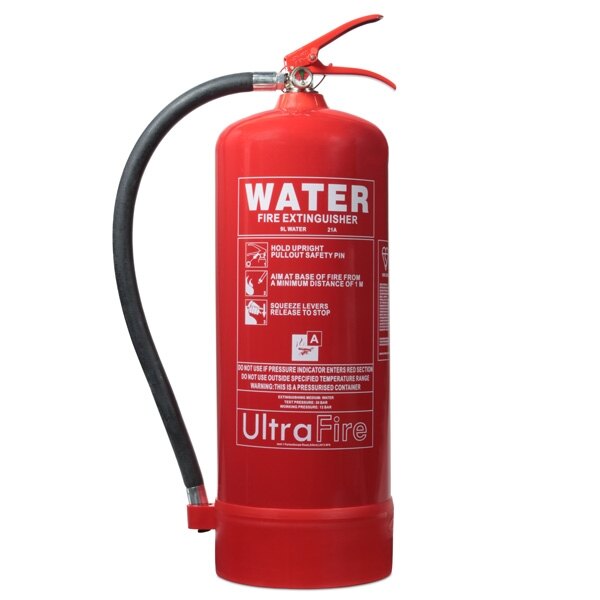
Water is the most common agent for class A fires and is quite effective as one would imagine. Water has a great effect on cooling the fuel surfaces and thereby reducing the pyrolysis rate of the fuel.
In the past, water-based extinguishers also contained traces of other chemicals to prevent the extinguisher rusting but are now lined with plastic. Some also contain surfactants which help the water penetrate deep into the burning material and cling better to steep surfaces. This is known as Water with Additives.
Water may or may not help extinguish class B fires; it depends on whether or not the liquid’s molecules are polar molecules. If the liquid that is burning has polar molecules, such as alcohol, there won’t be any problem. If the liquid is non-polar, such as large hydrocarbons, eg petroleum, the water will sink through the oil until it reaches the heat layer and then it is immediately converted to steam, ejecting the burning contents in a violent eruption, known as a boil-over. Even if the water is not erupting it will sink to the bottom and replace the oil until the flaming oil flows over the edge of the container thus spreading the fire; this is known as a slop-over. This is why you should never use water on oil fires. The only exception are water mist extinguishers, which produce a mist so fine that it does not penetrate the surface of the burning liquid. It forms a cooling water steam above the liquid and stops the supply of oxygen and removes the radicals.
Traditional water extinguishers sprayed on an electrical fire in a solid jet could cause the operator to receive an electric shock. However, if the power can be reliably disconnected, clean water will actually cause less damage to electrical equipment than will either foam or dry powders. Special spray nozzles, equipped with tiny rotating devices will replace the continuous water jet with a succession of droplets, greatly increasing the electrical resistance of the jet.
In particular water mist extinguishers with de-ionised water have overcome the issue of conductivity as the mist cannot conduct electricity and the use of the mist does not create puddles that could cause electrocution.
Water Mist Extinguishers
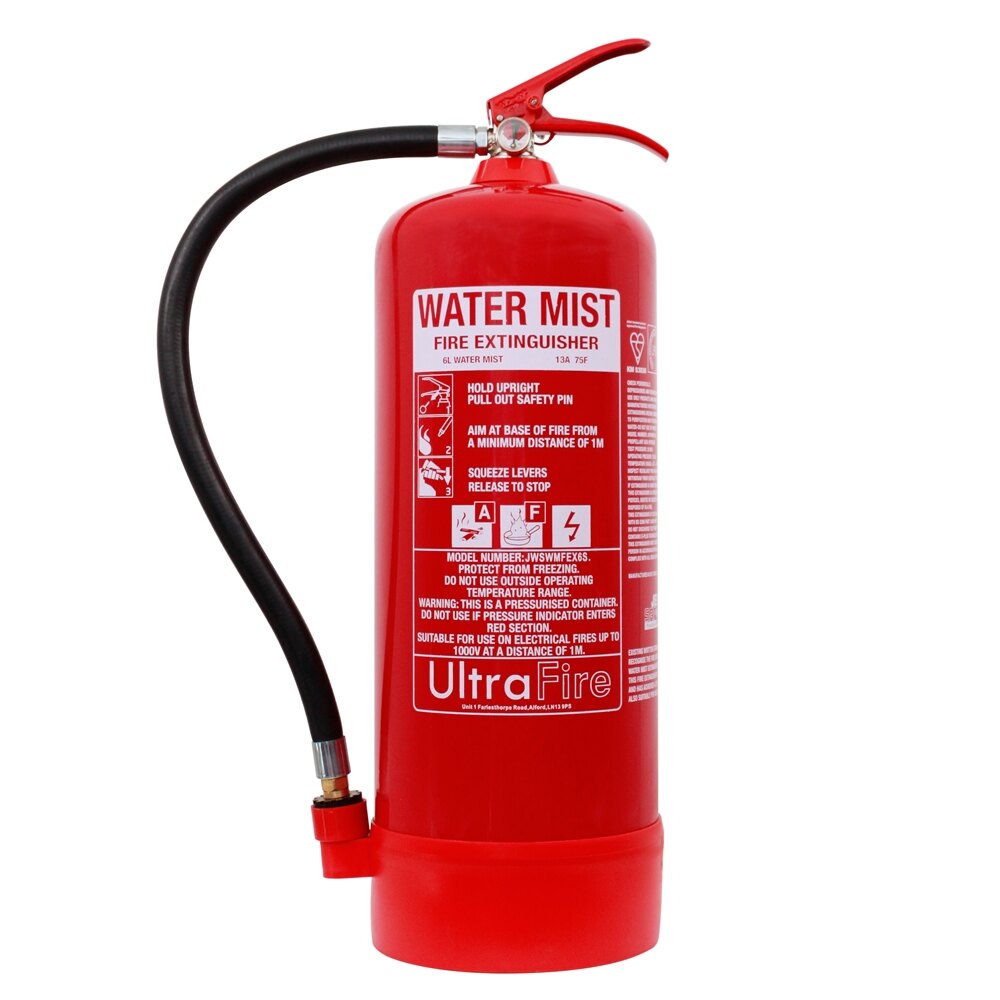
Water fog nozzles used by fire services create water droplets small enough to be able to extinguish flaming gases and are very efficient in putting out fires. The smaller the droplets, the greater the effect on flaming gases created by the fire. With this in mind portable water mist extinguishers were developed. The non-conductive de-ionised water and the unique nozzle which disperses the water as microscopic particles makes these extinguishers also very safe for use on electricity. These water mists pass the 35kV test and do not form puddles that could conduct electricity.
All water mist extinguishers break up the water in fine mist particles which soak and cool the fire. The particles also evaporate just above the surface, rapidly expanding in size and thus starving the fire of oxygen. Some models use rotors mixing nitrogen and water to achieve the fine water particles required.
Important: A number of brands, eg UltraFire deploy de-ionised water, which cannot conduct electricity. Those models can be used on electrical equipment with up to 1000V live electricity (1m safety distance). UltraFire water mist extinguishers are therefore suitable for most risks found in homes and offices. The risks covered are soft furnishing, paper, wood, oil, petrol, live electrical equipment up to 1000V and small fat fires.
Water mist particles do not sink under the surface of burning liquids, therefore avoiding the violent eruptions caused by traditional water based extinguishers when used on hot liquids and fats.
Water mist extinguishers filled with de-ionised water can also be used on people or animals as they do not contain chemicals, and the mist jet does not cause harm to people or animals even at very close distance.
The mist jet from the extinguisher creates a cooling barrier between the user and the fire, making the extinguisher very safe to deploy. The mist also clears smoke particles from the fire, helping with visibility and reduces inhalation risks from being near a fire.
Water mist (when containing de-ionised water) can often be used on valuable equipment, antiques and other vulnerable items, as they are residue-free and only lightly wet the surfaces.
Foam Extinguishers
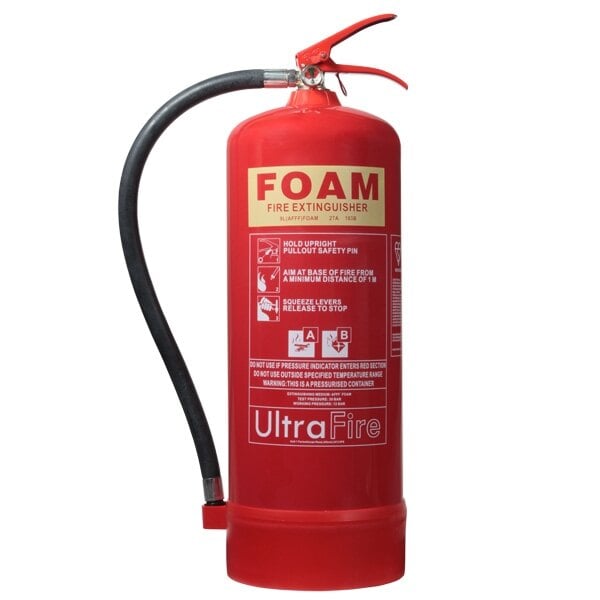
Foam Extinguishers are commonly used on class A fires, with AFFF foams also being suitable for class B fires (burning liquids). Foam extinguishers are mainly water-based, with a foaming agent so that the foam can float on top of the burning liquid and break the interaction between the flames and the fuel surface. Ordinary foams are designed to work on non-polar flammable liquids such as petrol, but may break down too quickly in polar liquids such as alcohol or glycol. Facilities which handle large amounts of flammable polar liquids use specialised “alcohol resistant foam” instead. Alcohol foams must be gently poured across the burning liquid. If the fire cannot be approached closely enough to do this, they should be sprayed onto an adjacent solid surface so that they run gently onto the burning liquid. Ordinary foams work better if poured but it is not critical.
Protein foam was used for fire suppression in aviation crashes until the 1960s development of “light water”, also known as “Aqueous Film-Forming Foam” (or AFFF). Carbon dioxide (later sodium bicarbonate) extinguishers were used to knock down the flames and foam used to prevent re-ignition of the fuel fumes. “Foaming the runway” can reduce friction and sparks in a crash landing, and protein foam continued to be used for that purpose, although FAA regulations prohibited reliance upon its use for suppression.
Foam extinguishers are now mainly used in offices as foam extinguishers cover most risks found in offices, and most of them are safe on electricity if they have been certified to 35kV and the operator keeps a safety distance of 1 meter from live electrical equipment.
AFFF is being phased out due to harmful chemical components. As the B rating is not required in most applications, AFFF are being replaced with water extinguishers and water mist extinguishers, all of which are capable of fighting class A fires. Due to the amount of electrical equipment in offices and living spaces, water mist extinguishers with de-ionised water (which cannot conduct electricity) are the most common extinguishing solution these days.
Powder Extinguishers
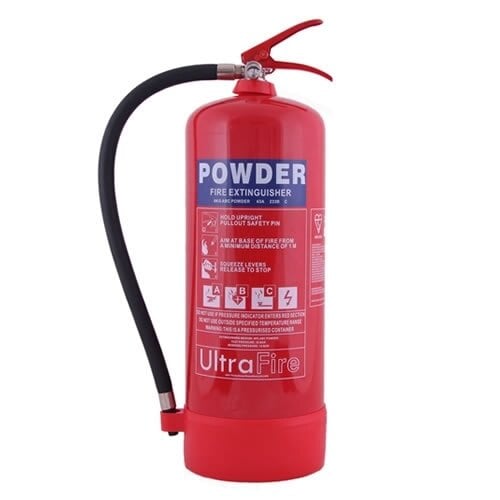
Principally there are two types of dry powder extinguishers in use, they are BC and ABC.
Class BC dry powder is either sodium bicarbonate or potassium bicarbonate, finely powdered and propelled by carbon dioxide or nitrogen. Similar to almost all extinguishing agents, the powder acts as a thermal ballast and makes the flames too cool for the chemical reactions to continue. Some powders also provide a minor chemical inhibition, although this effect is relatively weak. These powders thus provide rapid knockdown of flame fronts, but may not keep the fire suppressed. Consequently, they are often used in conjunction with foam for attacking large class B fires. BC Powder has a slight saponification effect on cooking oils & fats due to its alkalinity and was used for kitchens prior to the invention of Wet Chemical extinguishers. Where an extremely fast knockdown is required potassium bicarbonate (Purple-K) extinguishers are used. A particular blend also containing urea (Monnex) decrepitates upon exposure to heat increasing the surface area of the powder particles and providing very rapid knockdown. Sodium bicarbonate powders, unless specially treated, are not compatible with Foams. Purple-K, Monnex and ABC Powders are generally less damaging and often are used with AFFF & FFFP, but compatibility must be borne in mind where powder and foam are used together and a higher application rate of foam allowed for.
Class ABC Powders are mixtures of ammonium phosphate and ammonium sulphate, ground to selected particle sizes and treated with flow promoting and moisture repellent additives. In addition to the particle surface extinguishing effect, ABC powders have low melting/decomposition points in the order of 150°C to 180°C. When these powders are applied to hot and smouldering surfaces, the particles fuse and swell to form a barrier which excludes oxygen and thereby completes the extinguishing process and prevents re-ignition. They are acidic in nature and are effective on Class A (flammable solids), Class B (flammable liquid/liquefiable solids) and Class C (flammable gas) fires. They are electrically non-conductive; however it is less effective against three dimensional class A fires, or those with a complex or porous structure. Foams or water are better in those cases. Most dry powder extinguishers in service, except aerosols, are ABC Powder. Different blends are available – the more ammonium phosphate, the more effective it is. Powder, specifically ABC powder is not permitted in or near aircraft as it can damage the metal superstructure.
Dry powders can also be used on electrical fires, but provide a significant clean-up and corrosion problem that is likely to make especially sensitive electronics and electrical equipment unsalvageable.
Although modern powders are non-toxic, the discharge of a powder extinguisher in a confined space can cause a sudden reduction of visibility which may temporarily jeopardise escape, rescue or other emergency action. For this reason water-based extinguishers are preferred in hospitals, old people’s homes and hotels. Powder extinguishers are prohibited in public service vehicles and minibuses by UK statute law for the above reason.
When used on class B fires, the powder must extinguish the whole fire area in an uninterrupted application or flashback will occur, unlike foam there is no physical barrier, it’s all or nothing. The lack of a securing blanket means there is a re-ignition risk. Also powder has no cooling properties, one of the reasons it is ineffective against class F fires, although it can extinguish the flame, the heat of the fat will cause immediate flashback.
There were powders available that were designed for fires in flammable metals. The first of the three main types in use was Sodium Chloride, for fires involving alkali metals such as sodium, potassium, zirconium, uranium and powdered aluminium which extinguished metal fire by fusing to form a crust. This excludes oxygen from the surface of the molten metal and a carbonaceous rafting agent prevents the powder from sinking into the surface of molten metal. The second was a Copper extinguishing agent specially developed by the U.S. Navy for fighting lithium and lithium alloy fires. The copper compound smothers the fire and provides an excellent heat sink for dissipating heat. Copper powder has been found to be superior to all other known fire extinguishing agents for lithium. Finally, Ternary Eutectic Chloride (TEC), developed by UKAEA for uranium fires, which works similarly to Sodium Chloride but it, is extremely toxic.
Wet Potassium Salts (Wet Chemical Extinguishers)
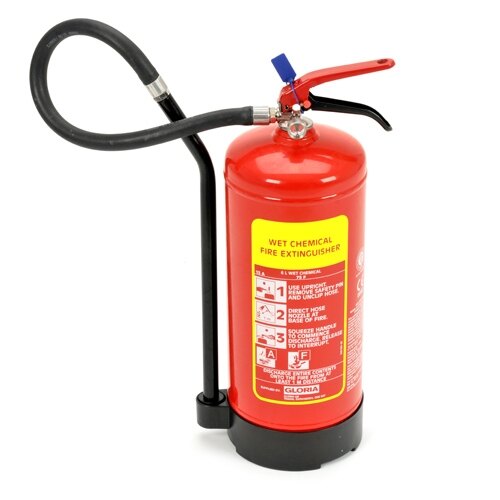
Most class F wet chemical extinguishers contain a solution of potassium acetate, sometimes with some potassium citrate or potassium bicarbonate. The extinguishers spray the agent out as a fine mist. The mist acts to cool the flame front, while the potassium salts saponify the surface of the burning cooking oil, producing a layer of foam over the surface. This solution thus provides a similar blanketing effect to a foam extinguisher, but with a greater cooling effect. The saponification only works on animal fats and vegetable oils, so class F extinguishers cannot be used for class B fires (although Gloria has developed a 3l version that also has a B rating). The misting also helps to prevent splashing the blazing oil.
Note: Saponify is a chemistry term which means to become converted into soap by being hydrolyzed into an acid and alcohol as a result of oil or fat being treated with an alkali.
Carbon Dioxide
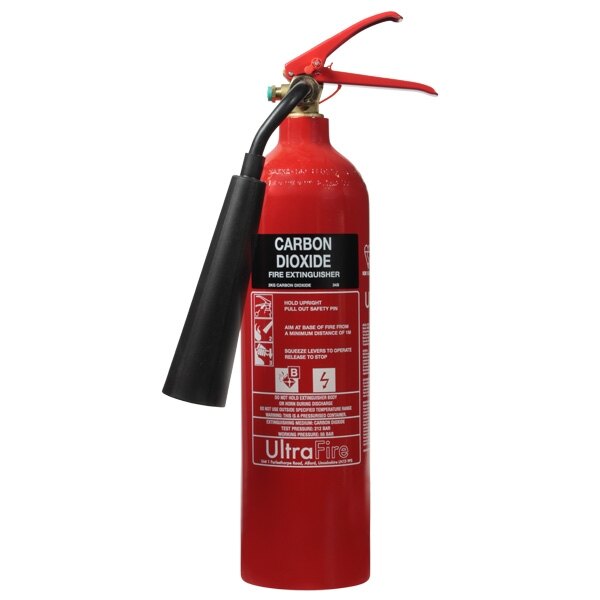
Carbon dioxide extinguishers (CO2) work on classes B by suffocating the fire. Carbon dioxide will not burn and it displaces air. Carbon dioxide can be used on electrical fires because, being a gas, it does not leave residues which might further harm the damaged equipment. Carbon dioxide has a discharge horn on the end of the hose which slows down the jet of gas and prevents air being entrained. Due to the carbon dioxide being expelled from an extinguisher, the horn becomes extremely cold and should not be touched. Use frost-free horns to reduce the risk of injury.
As CO2 disperses after use, CO2 extinguishers have a risk of re-ignition. There is also the risk of asphyxiation when used in small rooms. The use of CO2 is now mainly focused on server rooms.
Halons
In the UK and Europe, halons are illegal except for certain specific aircraft and law enforcement uses. This appears to be at least partially in response to the Montreal Protocol and effort by the United Nations Environment Programme (UNEP) to combat release of quantities of harmful chemicals into the atmosphere.
Halon fire extinguishers are still legal in America and are very versatile extinguishers. They will extinguish most types of fire except class D & F and are highly effective even at quite low concentrations (less than 5%). Halon is a poor extinguisher for Class A fires, a nine pound Halon extinguisher only receives a 1-A rating and tends to be easily deflected by the wind. They are the only fire extinguishing agents that are quite suitable for discharge in aircraft as other materials pose a corrosion hazard to the aircraft. The major extinguishing effect is by disturbing the thermal balance of the flame, and to a small extent by inhibiting the chemical reaction of the fire. Halons are chlorofluorocarbons which cause damage to the ozone layer and are being phased out for more environmentally-friendly alternatives.
Halon extinguishers were used widely in vehicles and computer suites. It is mildly toxic in confined spaces, but to a far less extent than its predecessors such as carbon tetrachloride, chlorobromomethane and methyl bromide.
Phosphorous Tribromide
Like Halon, phosphorous tribromide interferes with the chemical reaction of the flame, marketed under the brand name PhostrEx. PhostrEx is a liquid which needs a propellant, such as compressed nitrogen and/or helium, to disperse onto a fire. As a fire extinguisher PhostrEx is much more potent than Halon making it particularly appealing for aviation use as a lightweight substitute. Unlike Halon, PhostrEx reacts quickly with atmospheric moisture to break down into phosphorus acid and hydrogen bromide, neither of which harms the earth’s ozone layer. High concentrations of PhostrEx can cause skin blistering and eye irritation, but since so little is needed to put out flames this problem is not a significant risk, especially in applications where dispersal is confined within an engine compartment. Any skin or eye contact with PhostrEx should be rinsed with ordinary water as soon as practical. PhostrEx is not especially corrosive to metals, although it can tarnish some. The U.S. EPA and FAA both approved PhostrEx, and the substance will find its first major use in Eclipse Aviation’s jet aircraft as an engine fire suppression system.
Fluorocarbons
Recently, DuPont has begun marketing several nearly saturated fluorocarbons under the trademarks FE-13, FE-25, FE-36, FE-227, and FE-241. These materials are claimed to have all the advantageous properties of halon, but lower toxicity, and zero ozone depletion potential. They require about 50% greater concentration for equivalent fire quenching.
Specialised materials for Class D
Class D fires involve extremely high temperatures and highly reactive fuels. For example, burning magnesium metal breaks water down to hydrogen gas and causes explosions. It breaks halon down to toxic phosgene and fluorophosgene and may cause a rapid phase transition explosion. It continues to burn even when completely smothered by nitrogen gas or carbon dioxide, in the latter case producing toxic carbon monoxide. Consequently there is no one type of extinguisher agent that is approved for all class D fires rather there are several common types and a few rarer ones. Each must be compatibility approved for the particular hazard being guarded. Additionally, there are important differences in the way each one is operated, so the operators must receive special training.
Some class D extinguishing agents include finely granulated sodium chloride, copper and graphite applied by an extinguisher, shaker, scoop or shovel. These extinguishing agents are suitable for sodium, potassium, magnesium, titanium, aluminium, and most other metal fires.
Finely powdered graphite, applied with a long handled scoop, is preferred for fires in fine powders of reactive metals, where the blast of pressure from an extinguisher may stir up the powder and cause a dust explosion. Graphite both smothers the fire and conducts away heat.
Finely powdered copper propelled by compressed argon is the currently preferred method for lithium fires. It smothers the fire, dilutes the fuel, and conducts away heat. It is capable of clinging to dripping molten lithium on vertical surfaces. Graphite can also be used on lithium fires but only on a level surface.
Other materials sometimes used include powdered sodium carbonate, powdered dolomite and argon.
As a very poor last resort dry sand may be used to smother a metal fire if nothing else is available. It should be applied with a long-handled shovel to avoid the operator receiving flash burns. Sand is, however, notorious for collecting moisture and even the smallest trace of moisture may result in a steam explosion, spattering burning molten metal around.
Categories:Miscellaneous Fire Safety Issues
March 15, 2011[Last updated: December 14, 2022]
Comments are closed here.