Merseyside Fire Liaison Panel Logo

Note for Guidance

The Fire Safety Advice Centre


Information, Application and Positioning of escape route signs


Index

Exit sign design
Introduction to BS 5499
Creating an effective sign systems
Further information

Exit Sign Design.

The Euro-sign versus BS 5499 sign

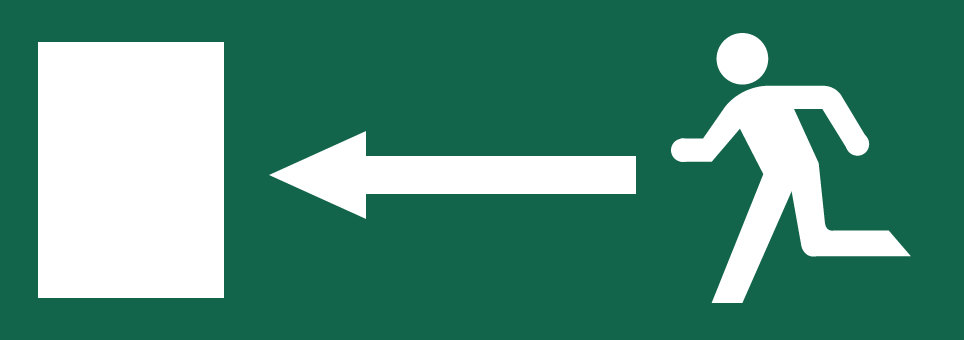
The Euro-Sign. combination fire sign
The BS 5499 sign.

This sign can be purchased
as a composite sign or
three individual signs.

Direction Arrow Running Man Exit in letters Sign

Ever since the introduction of the EEC Directive (EEC/92/58), the sign industry has been total confusion and uncertainty has spread amongst those who need to specify fire signs. There are two main types of emergency exit route and final exit signs in use in the UK. The first is based on the designs shown, in the British Standard BS 5499: Part 1 and the other commonly known as the 'Euro-sign' is based on the designs shown in the EEC Directive (EEC/92/58). In all the confusion, many are unsure of which is the most effective and which one should be specified according to good practice.

The History.

Fire exit route and final exit signs were originally text only and included an arrow for travel direction only when appropriate. However, the European Community decided that there should be a sign or series of signs that should offer a common language of communication across European Community states. It was decided that a graphical symbol or pictogram should he the main element of the sign design. enabling it to be understood independently of spoken and written language. The EEC Directive (EEC/92/58) was produced to deal with the sign design criteria of prohibition, warning, mandatory; escape routes and final exit signs. It is the criteria specific to the escape routes and exit signs shown in the Directive that has caused the 'Euro-sign' to become so widely used.

Annex 2, Minimum General Requirements Concerning Signboards, section 1.3. discusses escape routes and final exit sign designs and shows the 'Euro signs' as examples of the design criteria, So, very simply, it is firstly the introduction of the EEC Directive (EEC/92/58) and in particular the reference to Annex 2 has resulted in the 'Euro-sign' design being chosen by certain sign companies. A number of sign companies particularly those in the fire industry readily accepted the requirements of the directive for a common language based upon graphical symbols. However, they recognised that research and work to develop this type of graphical symbol had been successfully implemented, the results contained within the BS 5499: Part 1: 1990 document. The BS symbols, which were also accepted by the Health and Safety Executive and HM Inspectorate, were chosen to meet the new requirements. With two official documents containing two different design styles in existence, it is no surprise that there now exists a cocktail of sign design within the UK's public and commercial buildings. As a result, the sign industry often clashes over which is the correct sign, neither sign can afford to he 'wrong'. They have set their production lines according to the sign design they choose, this is a considerable capital cost, but the potential cost of replacing signs, sold, which could become a demand, if their sign type was proven to be less than acceptable, must also he considered.

ISO 7010 is soon to become PR EN 7010 and entitled - Graphical symbols - Safety colour's and safety signs - Safety signs used in workplaces and public areas. Its going from being an international standard, which is essentially a recommendation on best practice, to a European Norm requiring that the contents of the standard is written into a EU countries Law. It will spell the death of a myriad of poor sign designs instead replacing them with a requirement for the same sign in every country for the same requirement. It will mean a fire exit sign in England will be the same as a it would be in France, Spain, anywhere at all in the EU. The so called Euro fire exit sign will be contrary to European standards.

The arguments

Once an EEC Directive is issued from Brussels it is mandatory for each member state to bring it into general debate within its own parliamentary system, a process which may lead to the passing of new legislation. In the UK, subsidiary legislation was introduced the form of the Health and Safety Signs (Safety Signs and Signals) Regulations 1996. It is important to note that both the Directive and the UK Regulations offer similar guidelines for the design of fire exit route and final exit signs. The signs given as reference are shown to illustrate the design criteria. These sections are advisory and were not intended as a rigid specification of sign design.

The principle objection of these documents is effective communication for fire exit route and final exit signs. The aim is to ensure that no matter which European Union country you may visit or live in, or whatever building you may find yourself in, you will always be able to recognise these important signs, since the graphical symbols are consistent and instantly understandable. It is in the interpretation of these documents that the argument between the two sign types has arisen.

The pro Euro-sign camp has taken the document and the illustrations as final examples, set in stone.
Meanwhile, the BS 5499: Part 1: 1990 camp has understood the main theme of' the documents, read the design criteria and made the decision that the graphical symbol shown in the British Standard best meets the requirements and should be the one specified. Under current legislation both types of signs are acceptable but the debate over which sign is better than the other remains.

Backing for BSI

The graphical symbols shown in the BS 5499 document were recently endorsed by the International Standards Organisation (ISO), which now uses them in its standard, ISO 6309: Fire Protection- Safety signs, as the design recommended for escape route and final exit signs. The symbols have undergone a rigorous comprehensibility research programme amongst a wide variety of states and were voted as the most understandable symbols. The signs shown in both the BS 5499 and ISO 6309 most effectively fulfil the design specification of the EEC Directive and have been developed according to excellent design practice.

Note: The above case on fire exit sign design is argued by Warren Hickson who says that signs designed to meet the requirement of BS 5499 offer clearer guidance than the euro-sign. He is a design and communications consultant to the sign industry however the choice is yours both appear to be legal.

Return

Introduction to BSS 5499

BSS 5499 : Part 4 : Code of Practice for escape route signing While good sign design practice is important, the correct application and positioning of those signs is of equal significance in ensuring an effective signing system is in place. The size and positioning of signs within a building should form a major part of the package. The British Standards Institution has developed a new Code of Practice that clearly and concisely deals with all aspects of the design of an effective escape route signing system. BS 5499: Part 4: Code of Practice for Escape Route Signing, published in 2000, which includes sections on:

  • System design
  • Escape route signs
  • Sign type, sign size and viewing distance
  • Construction durability and suitability
  • Servicing and maintenance
  • Illustrations (use of safety signs)
  • Use of arrows to indicate direction of travel

It deals with the issues associated with designing a co ordinated system of signing throughout any given building. The code outlines items that need to be addressed in considering the overall design, including,

  • Results of any fire risk assessment ( The Regulatory Reform (Fire Safety) Order 2005)
  • Requirements (if any) of enforcing authorities
  • Operational needs of the building managers
  • Convenience of the users of the building, both workers and Public

The code stresses that it is only through the consideration of these factors that an effective design system for escape route signing can be achieved. It provides clear guidance on how to do this.

Return

Creating an effective sign system

The Code lists seven elements that must be addressed to create an effective sign system,

Correct choice of sign design

Signs should provide clear, unambiguous instruction that will lead people directly to a final exit out of a building.

Location of signs

Incorrect positioning can cause confusion and in the case of an emergency; could be life threatening. There are basic principles for sign positioning. These include defining the shortest travel distance from various evacuation starting points to the escape route. If at any place there is a choice of two escape routes of equal travel distance, both routes should be indicated by a separate series of signs. The Code expands upon these points, clearly defining the principles surrounding the subject of sign location.

Mounting Height

Signs are often mounted at unusual heights. Quite commonly a final exit sign is mounted in the middle of the door, as though it were a design feature. Fitting in with the decor should not be a consideration in overall sign system design. The Code offers clear advice on mounting heights and deserves careful study.

The use of supplementary text

Supplementary text helps to ensure that the meaning of the graphical symbol, now compulsory on all fire safety signs, is fully understood and may convey additional information. Again the Code offers good advice.

Use of arrows

Arrows are probable the clearest and most common of all the graphical symbols found in everyday life. But, if used incorrectly, they can result in people getting lost. At best this can lead to frustration, at worst it may result in life loss. Arrows must be used with care, correct identification of direction on an escape route is critical and once again the code offers excellent advice on the use of directional arrows.

Sign size

Size does matter when it comes to signs. Sign size is calculated according to the furthest distance from which it is required to be read. The size of sign necessary to achieve this criterion will depend upon both the viewing distance and the illumination of the sign. This section of the code offers comprehensive tables enabling correct calculation for sign size for both internally and externally illuminated signs.

Position of signs

It is here that the Code excels. This section describes various scenarios found on escape routes. With the use of clear illustrations it shows the type of sign required and how it should be positioned. The code also offers information referring to the correct use of supplementary text, sign location and fixing methods.

Return

Further Information

BS 5499-1:2002 Graphical symbols and signs. Safety signs, including fire safety signs. Specification for geometric shapes, colour's and layout.
BS 5499-2:1986 Fire safety signs, notices and graphic symbols. Specification for self-luminous fire safety signs.
BS 5499-4:2000 Safety signs, including fire safety signs. Code of practice for escape route signing.

The British Standard should be available from your local reference library.

Further information will be available from BSI website

Return


This handout provides a general overview and basic information on this topic. It may not apply to everyone, consequently to find out if this guide applies to you and to get more information on this subject, study all the relevant legislation, guides and British/European Standards. Also you should seek advice from an expert on the subject or your local Fire Safety Officer or Fire Safety Professional.

I would be much obliged if you would sign the guestbook and make your comments about the web site. Also include your constructive criticism on the site and inform me if any information which is out of date so I can research it to bring it up todate. This will enable me to improve the site and make it more relevant to its users.

Merseyside Fire Liaison Panel Logo

Merseyside Fire Liaison Panel. Permission is granted to print and photocopy this material for nonprofit educational uses.

[Index]

This page was last checked and modified on Thursday, 8 July, 2010 22:26

Valid XHTML 1.0 Transitional Connect Internet Solutions Logo