Carriage of Dangerous Goods (Signs)
Introduction
The Carriage of Dangerous Goods and Use of Transportable Pressure Equipment Regulations 2009 (CDG 2009) and the European agreement ADR which together regulate the carriage of dangerous goods by road are highly prescriptive. The regulations were substantially restructured for 2009 with direct referencing to ADR for the main duties. CDG 2009 now cross-refers almost totally to ADR, and it is ADR that contains the detailed requirements. We are not experts in this field and this legislation is very complicated, so always ensure that you double check the information stated. The following are simple images of the signs (Labels) used.
Class 1 Explosive substances and articles containing explosives
Explosive substances and articles used to produce explosions or pyrotechnic effect
 |
1.1 – Explosives with a mass explosion hazard | 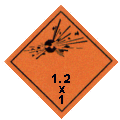 |
Division 1.2 – Explosives with a severe projection hazard |
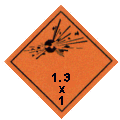 |
Division 1.3 – Explosives with a fire, blast or projection hazard but not a mass explosion hazard | x = Place for compatibility group – to be left blank if explosive is the subsidiary risk | |
 |
Division 1.4 – Explosives with a minor fire or projection hazard |  |
Division 1.5 – An insensitive substance with a mass explosion hazard |
 |
Division 1.6 – Extremely insensitive articles | x = Place for compatibility group – to be left blank if explosive is the subsidiary risk |
Class 2 Gases
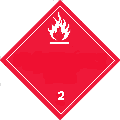 |
Division 2.1 – Flammable gasWhite on red or Black on Red |  |
Division 2.2 – Non-flammable, compressed gas Black on green or White on Green |
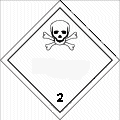 |
Division 2.3 – Toxic gas |
Class 3 Flammable liquids
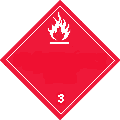 |
Division 3 – Flammable liquids White on Red or Black on Red |
Class 4 Flammable solids
 |
Division 4.1 – Flammable solids self-reactive substances and solid desensitized explosives |  |
Division 4.2 – Substances liable to spontaneous combustion |
 |
Division 4.3 – Substances which, in contact with water, emit flammable gases. White on Blue or Black on Blue |
Class 5 Oxidising agents
 |
Class 5.1 – Oxidizing substances | 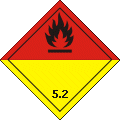 |
Class 5.2 – Organic peroxides Symbol Black or White |
Class 6 Toxic substances and Infectious substances
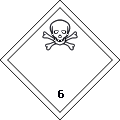 |
Class 6.1 – Toxic substances |  |
Class 6.2 – Infectious substances |
Class 7 Radioactive material
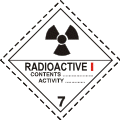 |
Radioactive material Category I-WHITE (Symbol 7A) | 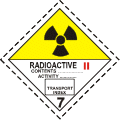 |
Radioactive material Category II-YELLOW (Symbol 7B) |
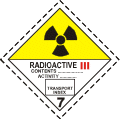 |
Radioactive material 7 Category III-YELLOW (Symbol 7C) | 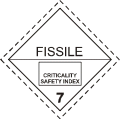 |
Radioactive material Criticality safety index label (Symbol 7E) |
Class 8 Corrosive substances, 9 Miscellaneous dangerous substances and articles
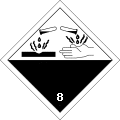 |
Class 8 – Corrosive substances |  |
Class 9 – Miscellaneous dangerous substances and articles |
Further labels
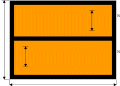 |
Orange-coloured plates, with hazard-identification number and UN-Number |  |
Indicating elevated temperature (liquid state at a temperature equal to or exceeding 100 °C, in a solid state at a temperature equal to or exceeding 240 °C) |
 |
Orientation arrows, black or red |
PLACARDS AND PLATE MARKINGS FOR NATIONAL CARRIAGE
United Kingdom Tankers (Road)
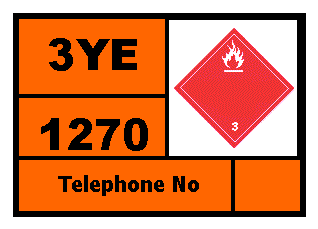
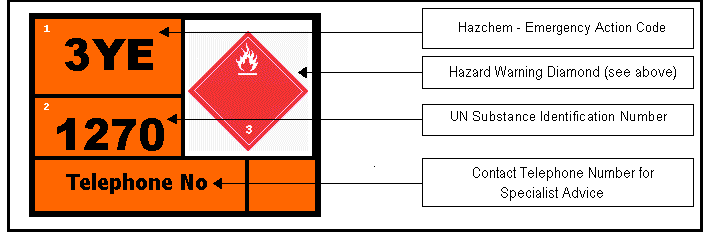
Continental Tankers (Road)
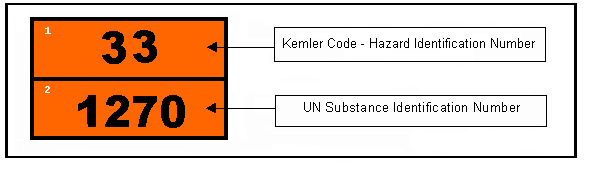
A plate known as a orange-coloured plate and displayed on vehicles and containers carrying hazardous loads is now included in the latest regulations (CDG 2009) It is designed to help the emergency services to deal with incidents involving such vehicles or containers.
The UK orange-coloured plate has more information than the continental plate and the first panel (1), which provides instant information for responding emergency crews, uses a different code than the continental plate. The UK uses an Emergency Action Code also known as Hazchem Code and the continental panel (1) uses a Hazard Identification Number also known as the Kemler Code. They both use the same system in the second panel (2) which is the UN Substance Identification Number.
Further Information
This legislation is very complicated and if you need information on this subject I have provided links which should prove useful. The most useful to start with is Development of dangerous goods legislation and the following links all relate to the subject.
The Carriage of Dangerous Goods and Use of Transportable Pressure Equipment Regulations 2009
Carriage of Dangerous Goods Manual
Categories:Fire Safety Legislation
June 6, 2011[Last updated: February 9, 2022]
Comments are closed here.