Fire Doors
Buildings are compartmentalised to delay the spread of fire from one area to another. These compartments are usually linked by fire doors to allow the flow of traffic around the building. Fire doors have two important functions in a fire; when closed they form a barrier to stop the spread of fire and when opened they provide a means of escape.
A well designed timber fire door will delay the spread of fire and smoke without causing too much hindrance to the movement of people and goods.
Every fire door is therefore required to act as a barrier to the passage of smoke and/or fire to varying degrees depending upon its location in a building and the fire hazards associated with that building.
The main categories of fire doors are FD30 and FD60 fire doors which offer 30 and 60 minutes fire protection.
Certification testing of timber fire doors
To determine the FD rating of fire doors, the manufacturers have their fire doors assessed by subjecting them to a test procedure as specified in BS 476-22:1987 or BS EN 1634-1:2014. Tests are made on complete fire door sets: ie. the fire door and door frame with all the requisite hardware (e.g. locks, latches, hinges, etc). The door set, as it is also known, is fixed in a wall representing its use in practice. The test procedure is fully described in the Standard and consists of exposing one face of the door to the heat conditions anticipated in a fire while observing the door for stability and integrity. The Standard requires the tests to be carried out with the upper part of the door under a small positive pressure, to simulate the conditions likely to occur in a fire. It also provides an objective method of establishing the loss of integrity of a fire door by the use of a combustible fibrous pad on the unexposed side of the door to see when it ignites. As a fire door should be tested from each side to establish its performance with either face exposed to fire conditions, two specimens are required. It is reasonable to assume that all fire doors and door frames manufactured to the same specification as the two specimen doors and frames will then achieve the same fire resisting properties.
| Fire resisting doors – door type for means of escape purposes | Integrity Minutes [1] |
Stability Minutes [2] |
| Half-hour fire-resisting | 30 | 30 |
| One-hour fire-resisting | 60 | 60 |
[1] Integrity failure is deemed to occur when cracks or other openings develop through which flames or hot gases can pass or when flaming occurs on the unexposed face.
[2] Stability failure is deemed to occur when collapse of the specimen takes place.
While fire doors are tested together with a fire door frame and certified as a fire door set, it is common for fire door manufacturers to sell certified fire doors by themselves for use with frames to be constructed by the installer from timber. The specification for the frame is either sent with the door or is available on the website of the relevant fire door certification scheme. These fire door leafs can also be used when replacing fire doors that have been damaged or where additional features such as vision panels are required etc. Fire door manufacturers also commonly send out fire door frames on their own with certification.
Fire doors with a rating in excess of FD6O are rarely used on escape routes or to protect people but may be found where the preservation of property is important e.g. data storage areas where documents cannot be removed in the event of fire. Some of these doors have the appearance of timber, but may be constructed with a mineral core. Expert assistance may be required to identify such door sets.
Identifying Fire Doors
Certified Fire Doors
Manufacturers can certify fire door sets, both for identification purposes and to guarantee their performance in a fire situation. The first step for the manufacturer is to construct a fire door set designed to a specification that, in their opinion, will resist a fire for a specified length of time. This door set will then be tested by an approved fire testing centre and, if it is passed, any door sets constructed to that specification can be considered for certification.
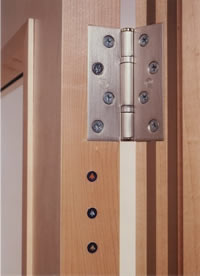
Once the certification is approved, each similarly constructed door set will be identified by a label identifying the manufacturer, the date of manufacture and the designated fire rating of the door type. This identification label is usually affixed to the top edge of the door. A colour-coded plug may be inserted into the door, instead of or in addition to the label. For hospitals, fire doors display a disc at the top of each face of the door showing the designated fire performance as per Health Technical Memoranda (HTM) 58.
Identification marks can sometimes be removed or painted over during the installation or adjustment of a fire door set but, if the work has been professionally carried out under the auspices of the BWF/FIRAS Accredited Fire Door Installers Scheme, the chance of this happening can be avoided. There are two associations that have certifiable fire door systems, namely:
British Woodworking Federation fire door scheme
The British Woodworking Federation (BWF) is another major organisation that provides fire door ratings. BWF fire ratings for fire door assemblies are stated in minutes and prefixed by the letters ‘FD’: e.g. FD30 refers to a 30-minute fire door or fire door set; in other words, one that offers at least 30 minutes of protection against fires.
The most commonly specified integrity levels are:
- FD30 – 30 minutes
- FD60 – 60 minutes
- FD90 – 90 minutes
- FD120 – 120 minutes
As part of the steps being taken by the BWF to simplify fire door identification and eliminate confusion in specification, the existing FD20 rating is no longer available.
TRADA Q-Mark fire door scheme
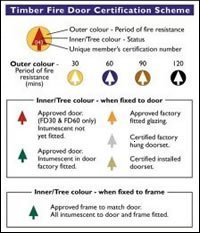
The woodworking association BM TRADA uses a system known as Q-Mark, in which a series of coloured plugs is inserted into the door to indicate the fire door type, member details, the scope of certification during specification and installation, and service history.
 |
 |
For more details visit the BM TRADA website at www.bmtrada.com, The colour coding information is summarized on a laminated plastic card, available free of charge from BM TRADA: contact enquiries@bmtrada.com.
Nominal Fire Doors
Nominal fire doors are door sets that are not certified but in the opinion of an assessor will hold back a fire for a specified period of time. Identifying nominal fire doors is very difficult but there are a number of clues that may indicate the door is a nominal fire door. A certified fire door that is installed into an existing, uncertified frame, can, at its best, only ever be a nominal fire door and it would be the installer’s responsibility to judge the suitability of the frame.
Fire Door Assemblies, where a fire door leaf is installed together with a new frame constructed by an installer from loose timber can only be a nominal fire door and again it is the installer’s responsibility to ensure that all components are suitable and that the frame matches the guidance from the fire door manufacturer. That said Fire Door Assemblies have been the traditional way of installing fire doors in the UK.
Is your door a fire door?
Older panel doors, especially if less then 44mm thick, are unlikely to be FD30. They could, however, have been upgraded or modified to achieve fire resisting standard. These days you might find certified paneled fire doors with wood surfaces to fit into traditional homes.
Hollow flush doors using egg box or similar construction will not be FD30. This can be detected by the weight of the door, because fire doors are much heavier than a hollow door. To check the weight of a door, instead of removing it, you can detach the self closer and swing the door between your thumb and index finger. This gives a good indication of the weight of the door. Hollow doors are reasonably easy to detect using this method.
Fire doors will have automatic closing devices (fire door closers) fitted. Spring-loaded self-closing hinges and concealed Perko door closers with chains might also be in evidence.
Because of the weight of a fire door and to prevent it warping, fire doors are usually fitted with three fire door hinges. The current BS EN standard does, however, allow two hinges in certain circumstances. There may be documentation that was supplied with a fire door giving you all the necessary information. Unfortunately, as there is no standard method of identifying fire doors other than the Q-Mark or the CERTIFIRE fire door schemes, insisting on written proof that a door meets all the necessary standards, for example a test certificate, might still be necessary.
Fire Door Seals or Fire and Smoke Seals
Intumescent fire door seals should be fitted to the stiles and head of a fire-resisting doorset.
These seals are fitted into grooves cut into the door or the frame, or alternatively, can be surface mounted. As soon as the temperature in the vicinity of the strips exceeds 200°C, usually about 10-15 minutes after the start of a fire, the seal swells and seals the gaps between door and frame.
- As smoke spread is an even greater threat to life and property than flames, particularly in the early stages of a fire, fire doors might also have to be fitted with a ‘cold smoke’ seal to prevent the ingress of smoke around the door edges (such fire doors would be specified as FDs fire doors). Exceptions apply where the leakage of smoke is essential for detecting a fire early.
Combined smoke and intumescent seals are available.
Not all intumescent materials act in the same way. Low pressure seals expand in all directions but provide little help to the door in resisting distortion under fire. Some high pressure seals exert pressure mainly in one direction and provide some resistance to distortion of the door leaf under fire. A further type of intumescent material, available in different grades, acts in all directions and generates some pressure. Fire door seals activate at temperatures that are above human survival levels. The following is information on the type or size of intumescent fire door seal that should be used.
| Type of fire door |
Intumescent Seals
|
Intumescent Fire and Smoke Seals
|
|
30/30 Single action door 30/30 Double action door |
(Both sides and top) |
(Both sides and top) |
|
30/30 Double pairs of doors
|
10mm x 4mm on one centre stile 10mm x 4mm on other stile, heads and back edges |
|
|
60/60 Single action door 60/60 Double action door |
20mm x 4mm (Both sides and top) |
20mm x 4mm (Both sides and top) |
|
60/60 Double pair of doors
|
20mm x 4mm on one centre stile 20mm x 4mm on other stile, heads and back edges |
|
Most modern fire door seals combine the intumescent and cold smoke elements in one seal.
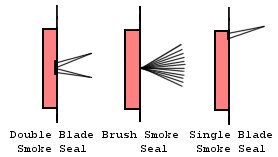
Grooves should be made slightly wider than the seals to allow for the pre-painting and shrinkage of timber.
Note: – It is advisable to ask fire door manufacturers what type of seal to use.
Fire Resisting Glazing
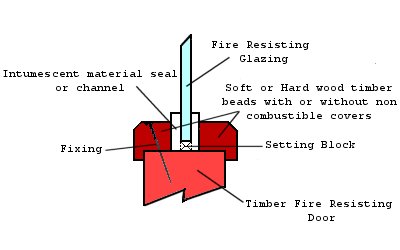
Glazing may range from a small vision panel in a door to a glazed screen for maximum light transmission and safety. Ordinary glass cracks when exposed to heat and is liable to fall out fairly early in a fire. Fire resisting glass can withstand exposure to the heat condition in a fire test for at least 60 minutes before it reaches a temperature high enough to soften it. This is mainly because, with clear FR glazing, nearly 50 per cent of the incident heat is transmitted through the glass by radiation.
The size of the glass and the method of its retention are important factors that influence its integrity. As the temperature approaches the softening point, a large sheet will tend to collapse earlier than a smaller one. On the unexposed face, beading retaining the glass is subjected to radiant and conducted heat through the glass and to convection currents at the top of the pane.
This can raise the temperature sufficiently to ignite timber beading after approximately 20 minutes. To delay the ignition of beading to 30 minutes, it is necessary either to provide protection by impregnation of a surface coating or a surface covering of non-combustible material or to fit a fire resistant glass secured using a fire resistant glazing system. This will hold the glass firmly in place during normal use, but in the event of fire, allows the intumescent material to expand, thereby securing and insulating the glass and protecting the surrounding timber.
For longer periods of fire protection, an improved retention system for the glazing is required. The glass panel should be small and the method of fixing must ensure that no direct path can be created for the transference of hot gases.
Fore more detailed information, visit the Glass and Glazing Federation and download the Fire Resistant Glazing Best Practice Guide.
Upgrading of existing doors
Years ago, it was accepted practice to improve the performance of an existing door to a half-hour fire-check or fire-resisting standard, although in some cases it was more economical to replace the door rather than alter it. The doors were usually panel type or a light core flush type about 44mm thick: they require a facing on the risk side with a non combustible board.
It is now the accepted practice to fit new fire doors and fire doorsets in preference to upgrading them but this is not always an option, as in the case of historic/listed buildings, for example.
These days you can configure and order entire fire doors with either 30 minutes (FD30) or 60 minutes (FD60) protection online. These fire doors can be configured with or without frame.
Suitability of doors for upgrading.
|
Door type |
Suitable? |
Comments |
| Unframed, hollow core, flush |
No |
Too light and insubstantial |
| Framed, hollow core, flush | ||
| Framed, solid core, flush |
Yes |
If core of flaxboard, timber or solid chipboard |
| Ledged and braced |
No |
Insufficient thickness at the edges to accommodate an intumescent seal |
| Framed, ledged and braced | Yes(20 mins only) | Extremely dependent on joints and fixings |
| Framed, solid with solid panels |
Yes |
Depends on thickness, minimum 44mm, and panel construction |
| Framed, solid with glazed panels |
Yes |
Depends on thickness, minimum 44mm and type/installation of glazing |
Methods of upgrading
There is no ‘one size fits all’ method of upgrading existing doors and the solution chosen will depend on the door construction, condition, situation and customer requirements. Techniques that have been successfully used in the past include:
Facing the door leaf with a non-combustible board
This is one of the easiest methods of upgrading, although it does create a visually unattractive result. It is, however, favoured by some heritage authorities as it a reversible process; removing the facing returns the leaf to its original condition. If used, facings should be applied symmetrically to each face (note that the increased thickness and weight may affect the door frame and ironmongery specification).
Sandwiching panels
For paneled doors, the weakest area is generally the panel itself. In many cases, the timber will be less than 10mm thick at the thinnest point. One method of upgrading is to remove the panels, split them through their thickness and insert a sandwich material – either an appropriate intumescent sheet or a non-combustible board. This is more difficult than other approaches but does enable the original finish to be maintained, which can be important for heritage projects.
Intumescent paper
Intumescent paper and card can be used selectively to protect vulnerable areas such as the fielded area of paneled doors. The application thickness is controlled by the thickness of the paper but can be veneered to restore a timber finish.
Intumescent paints and varnishes
Intumescent paints and varnishes are available for use on timber-based fire resisting doorsets where a maximum performance of 30-minute integrity is required. These products require extremely specific application techniques and are reliant on the underlying condition of the doorset construction. Great care should be taken to ensure that full-scale test data for the product is both available and appropriate for the application in question.
It is likely that other upgrading measures will be required in conjunction with any of these measures.
Fire Door Furniture and Ironmongery
An important aspect of ensuring fire doors meet the required standard is the fitting of certified door furniture, or hardware, which is overlooked on many occasions. If you go to our page Fire Door Fittings and Ironmongery there is a detailed description of all the door furniture suitable for fire doors and the appropriate standards.
Maintenance of Fire Doors
Fire doors are engineered products that provide life and property saving functions in the event of fire. It is important that they are regularly inspected and maintained to permit them to perform at their best on the one and only occasion when they are called upon to do so.
Doorsets fitted with hold open devices or swing free type closers should be closed daily, particularly overnight when there is likely to be low building occupancy. For busy 24/7 buildings (e.g. hospitals) fire doors should be closed at least weekly. All fire doors should close effectively from any angle of opening, using only the door closer.
There are a number of reasons why doors may fail to close:-
- Foreign bodies or other objects may be obstructing the door.
- The smoke seals may be incorrectly fitted or damaged.
- If a latch is fitted, it may be malfunctioning or require lubrication.
- The closing device may need adjustment but this must only be done as a last resort and very carefully, to ensure that the door can be opened without undue force.
Intumescent seals should be checked regularly, at intervals not greater than 6 months, and damaged or missing ones replaced. To maintain the designated performance potential, replacement seals should be of the same brand, size and type as the original. Any intumescent seal of the same size as the original, however, is better than none.
Mechanical items such as hinges, locks, latches, closers, floor springs etc are likely to wear over time. Maintenance provisions should comply with the hardware supplier’s recommendations where these are known. Otherwise, locks and latches may require occasional light lubrication.
Some hinges use self-lubricating bearings that will not need additional lubrication.
Where it is necessary to replace worn hardware on a fire door, the essential items should be replaced with products to the same specification as the original where possible. Otherwise, hinges, latches, locks, flush bolts, closers and other items of load-bearing or securing hardware should be of the same type and size as the original items and should have been proven for use in timber fire rated doorsets of the required performance. Hardware that has been successfully tested in metal doorsets may not be suitable for use with timber doorsets. Intumescent gaskets may have been used under hinge blades, locks/latches for end plates, strike plates, and/or with closer fittings and in flush bolt recesses. These gaskets should ideally be replaced if possible with gaskets of the same material; alternatively, if undamaged, they should be retained and reused with the new fittings. Intumescent gaskets or mastics used for these applications are usually the low pressure type.
Redundant hardware should be carefully removed.
How big should gaps around fire doors be?
Best practice guidance states that the gaps at the sides and top of a timber fire door should be between 2 and 4mm. You can measure the gap with a simple gap gauge. Safelincs provides gap gauges free-of-charge on request.
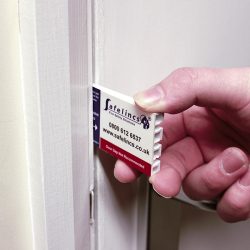
Underneath the fire door, a gap of 8mm is traditionally acceptable, although for fire doors that are required to limit spread of cold smoke only 3 mm is permissible with a threshold seal to be fitted if the gap is bigger.
How much can you cut off a fire door?
Nothing must be cut at the top at all and the certification label must remain intact. At the sides, small adjustments of 1 to 3 mm are usually permitted. However, this amount varies with each fire door model and you need to ask the manufacturer for the maximum amount before starting to remove material.
Decoration
Unglazed areas of any fire door leaves are generally not required to provide a specific surface spread of flame requirement and may therefore be decorated as desired. There is no evidence to suggest that over-painting of heat-activated seals has any detrimental effect on the ability of the seals to perform efficiently. There are some benefits in over-painting the seals as they are less likely to absorb atmospheric moisture. There are limits, however, on how much paint can be applied without there being a risk of the seal being rendered inoperative. It is recommended that over-painting be limited to a maximum of five coats of conventional oil bound paint or varnish. When preparing a frame for redecoration, the use of heat or chemical strippers should be avoided if intumescent seals are incorporated. If seals are damaged by either of these processes, they should be replaced. If glazing beads have been painted with intumescent paint, it is essential that they are repainted with a similar paint. Further reading: BS 8214:2016 Code of practice or fire door assemblies, clause 14 Decoration
British Standards
The following is a list of documents relevant to timber fire doors BS 476: – 20: 1987 Fire tests on building materials and structures. Methods for determination of the fire resistance of elements of construction (general principles)
BS 476 – 22: 1987 Fire tests on building materials and structures. Methods for determination of the fire resistance of non-loadbearing elements of construction
BS 476: – 23: 1987 Fire tests on building materials and structures. Methods for the determination of the contribution of components to the fire resistance of a structure
BS 476: – 31.1: 1983 Fire tests on building materials and structures. Method of measuring smoke penetration through doorset and shutter assemblies – method of measurement under ambient temperature conditions.
BS 8214:2016 Code of practice for fire door assemblies
BS EN 1634-1:2014 Fire resistance and smoke control tests for door, shutter and openable window assemblies and elements of building hardware. Fire resistance tests for doors, shutters and openable windows which is an alternative for BS 476 – 22: 1987
Additional Information
Building Research Establishment (BRE) produce research documents called BRE Digests and one on fire doors has been produced. BRE Digests are obtainable from BREbookshop.
If you require more in-depth information, go to Architectural and Specialists Door Manufacturers Association and download the ASDMA Best Practice Guide to Timber Fire Doors.
The Fire Door inspection Scheme (FDIS) provides professionals with an on-line education programme leading to a Diploma in Fire Doors, and a route to become a Certificated Fire Door Inspector. FDIS Inspectors will help those with legal responsibilities for fire safety to ensure the safe functioning of fire doors.
Categories:Fire Safety Equipment
March 14, 2011[Last updated: April 9, 2021]
Comments are closed here.